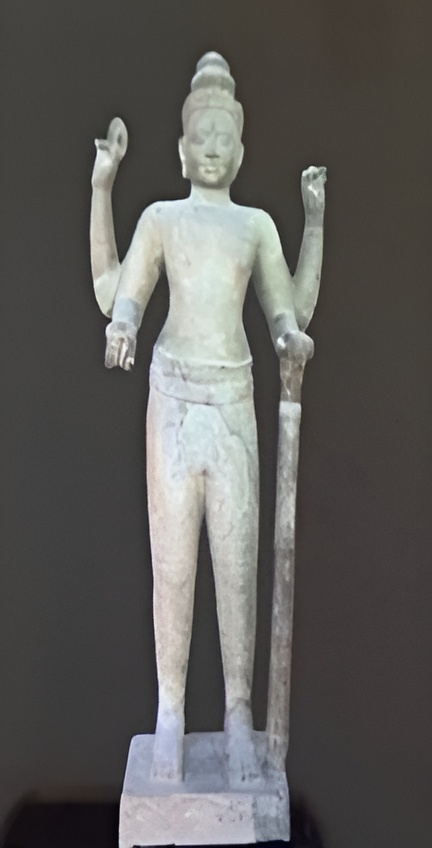
This is a sandstone statue of Vishnu. It originated from a gallery of the Bakong Monument, which is the first mountain temple at Hariharalaya, in the Roluos region of Siem Reap province. It was registered into the collection of the National Museum of Cambodia in 1951.
Experts of Khmer art say this statue belong to the Preah ko style, of the late 9th century, Angkor period. This statue was sculpted in Hariharalaya, the capital of King Indrawarman I. the figure is in an erect posture, with the chest bulging to display immense authority. In studies of Khmer iconography, experts note a major transformation, especially in the art of sculpture. For this reason, they classified this Preah ko style statue in the Angkorian period.
This period saw a complete abandonment of the use of the horseshoe-shaped support mechanism. The flexed form of the statues ceased and was replaced by an erect still posture. The cylindrical crown of Vishnu’s was replaced by a cone with layered lotus petals on the exterior as decoration. Instead of using a large belt to tie the sampot, it is folded and tucked in at the waistline, with fringes hanging loosely in the front.
All these features are characteristics of the Preah Ko style of 9th-century. This statue is in good condition along with all the attribute’s characteristic of Vishnu, a globe, the mythical disc, the conch, and a stick.