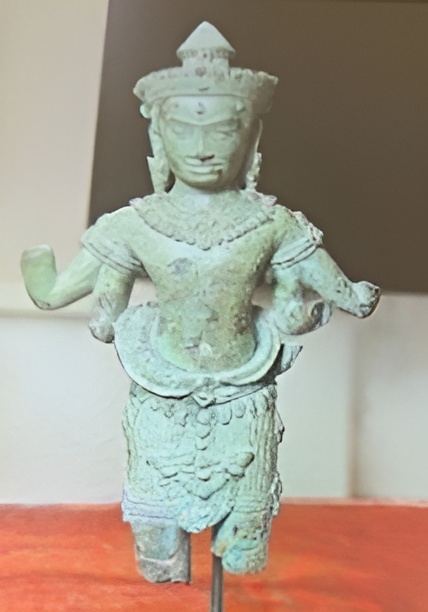
“It is unfortunately, quite difficult to determine the identity of this deity figure due to the fact that it has lost all four arms, which prevents us from identifying its previous held attributes. It is a Male divinity made from bronze. The work originated from Pursat province and was one process by Mr. Vardes who’s donated to the National Museum.
Local authorities transfer it in to the collection of the National Museum in 1944. Khmer art experts have determined that this item was created in the 12th century Angkor era. It is commonly perceived that a statue with four arms as Vishnu and with a third eye on the forehead is Harihara. If we compare this with statue number 18, although there is a third eye on the forehead this was a norm since the pre-Angkorian era.
In our view this statue is a meditation guru. Another similarity is the sign on the chignon that read OM in Sanskrit. The hairstyle appears in a form of a cone, another characteristic of Vishnu that is feature of the scenes of the churning of the Sea of Milk on the walls of Angkor Wat. The figure wears a sampot and is also adorned in jewels.
However, the look and body posture appear closer to the Ba Puon style that is livelier, unlike statues of the Angkor Wat style that appear more formal and stiffer.”