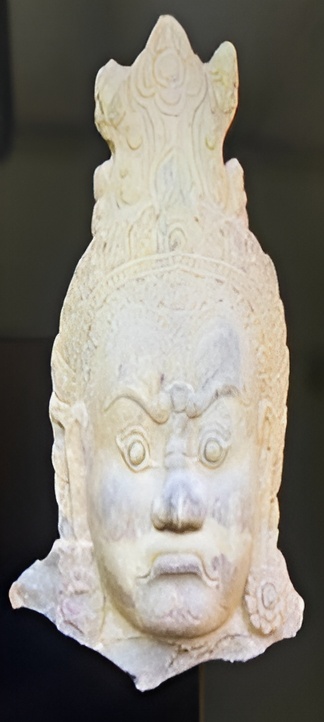
This is a sandstone Head of Yaksa. The giant head has been brought from Banteay Chhmar Temple, Banteay Meanchey province, to be displayed and later registered in the collection of the National Museum. It has been classified as an Angkorian era masterpiece in the Bayon style, the date to the 12th and early 13th centuries.
This corresponds to the period of rule of King Yayawarman VII, from the year 1181 to 1218 CE. Banteay Chhmar was among the most important temples built during his reign. It is located in Banteay Chhmar commune, Thmor Puok district, Banteay Meanchey province. Architects and artists sculpted giant heads to decorate the entrances to the temple complex. This head reflects a careful and thorough artistic undertaking.
The hair is neatly molded into an upright position and studded with two Bopha leaves, to signify good luck. The forehead wears a semicircular crown that have two layers of lotus flower patterns as decoration. Its facial expression shows seriousness, anger, and savagery. the eyes although appearing tiny compared to the size of a face, bulge out the eyebrows curved in the separated only by a floral dot in the center.
The nose curved downward like a Garuda’s beak. The upper and lower lips bent like a bow to depict the viciousness of the giant should exhibit. Hanging on the ears is a pair of earrings that are sculpted in the shape of a flower.
According to available historical records, this giant head could be among the statues that were erected at the entrances to major Angkorian monuments, especially those built using the Bayon style, for instant at Preah Khan and the Bayon temples. There, the heads of giants and Nagas-railing are symbols that derived from Hindu mythology. They depicted scene in which Tevada and Ashoka took part in the challenge to churn the ocean of milk in order to extract a retrofit.