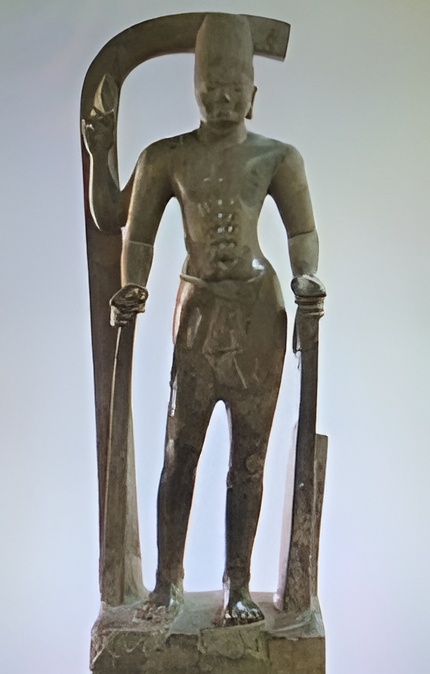
This is a sandstone statue of Harihara. It originated from Temple Tower and 11 of the Sambour temple group. The Sambour Preykuk temple group is located in Sambour village, Sambour commune, Prasat Sambour district in Kampong Thom province. For the purpose of study and registration, the entire complex is divided into different temple groups with coded letter. N for the Northern Temple Group, C for the Downtown Center Temple Group and S for the Yei Puan Temples Southern Group. This statue entered the collection of the National Museum of Cambodia in 1930. Experts have determined that is belongs to the Sambour Preykuk style, has the begging of the 7th century. It is from the pre- Angkorian era, under the rule of King Isan Warman I, from the year 616 to 635 CE. The statue has suffered a great deal of damage. The horseshoe-arched frame, that was originally designed to be a support structure for the sculpture, is partially broken. Remaining as an attribute is the chakra, in the upper left hand of the statue. It has been identified as Harihara because the right half of the head is that of Shiva. The hair is folded up in a chignon. The left side of the head wears a crown which signifies Vishnu. The forehead has a half section of an eye, part of the third eye of Shiva, and build a smile on his face. The abdomen was in sculpted to the expose the muscular forms. The arms are slim, which is one of the characteristics of the Sambour Preykuk style. This statue is a merger of two deities, Shiva on one side and Vishnu on the other. This type of Hindu statue was mostly sculpted primarily the pre-Angkorian period./.