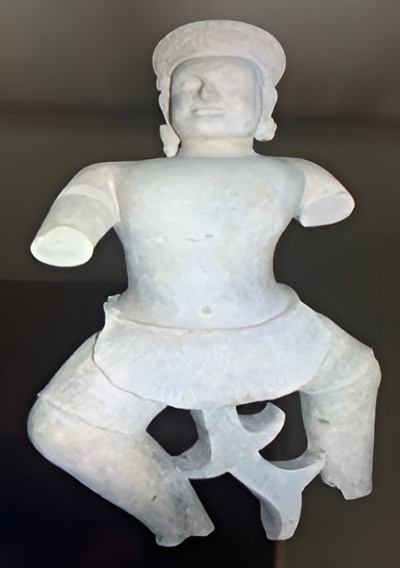
This is a statue of Duryodana made of grey yellow-sandstone. It originated from the western gate of Prasat-Cheng, Kho Ker, in Kulen District, Preah Vihear Province.
It is in the Koh Ker style of the first half of the 10th century, Angkorian period, during the reign of King Jayavarman IV, from the year 921 to 941 CE. Duryodana is a character in Mahabharata mythology, in which he is the main rival to Bhima. In this statue he is standing on three-tiered, four-sided base. His right foot is in a forward position, with the knee slightly bent.
The left foot is also bent at the knee and turned sideways. The upper part of his body is bare, while the lower part is dressed in a sampot Chong Kben, with a crescent fringe of the garment in the front. The sampot is tucked under two-layered belt. The portion of his tail or Kantouy kben which is left from the knot behind the back. Stretches all the way to the base to help stabilize the statue. It has fringes that resemble fishtails.
The statue has a serious face, with eyes wide open and the connected eyebrows. His mustache and beard are obvious in contrast to the carvings on the faces of Bhima, Balarama, and the Pandava. He wears a crown with a diadem on the front.
The crown held by a string is sculpted in the mountain shape with five-tiered. The ears wear earrings that have pointed pendants. Duryodana means “”the unbeatable in battle.”” He is the oldest of the Kaurava family and also a son of Doshka Dhyomana. Both the Bhima and Duryodhana statue, were stolen in the 1970s when Cambodia was rocked by a civil war that lasted over three decades.
After Duryodhana statue was taken from Prasat Chen, Koh Ker temple, it was seen again for the first time in decades, being listed for sale at an antique black-market named Sphinxon in London, United Kingdom.
On 24 of March 2011, an antique dealer, Sotheby’s in New York, put this statue up for auction. On 29 of May 2014, Sotheby’s returned it to Cambodia, where it was immediately registered in the collection of the National Museum of Cambodia. If you want to learn more about the history of the repatriation of Koh Ker statues to Cambodia.