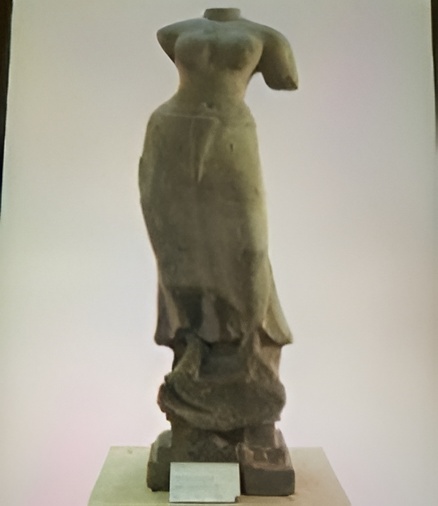
This is a sandstone statue of Durga defeating a demonic buffalo. It originated from towers number 1 and number 9 of the Northern of Monuments Group in Sambo Prey Kuk temples, Sambo commune, Prasat Sambo district, Kompongthom province. It was brought in for safekeeping and entered the collection of the National Museum in 1920. when the museum was officially inaugurated. It is in the Sambo Prei Kuk style of the 7th century, pre-Angkorian period, during the reign of King Isamburman I from the year 616–635 CE. This is the rare masterpiece, produced by ancient Khmer artists. Durga is a well-known deity in Brahmanism and was highly popular in ancient Khmer society. She is a deity related to Shiva, Vishnu, and Brahma, and is the combination of the might of all the deities that defeated the demonic buffalo upon which she stands. Unfortunately, the figure buffalo has been broken beyond recognition. The fact that the statue shows a tri-flexed body indicates the influence of Indian art at that time. The head and arms are missing, yet the torso and embodies naturalism vivid characteristics, a slim figure, wide hips and bulging breasts a universal model of feminine beauty. In India, the face of Durga usually shows rage as she stands on the buffalo, but in ancient Khmer art, she was sculpted in a way that gave prominence to her beauty, mixed with the undefeated power she possessed. Her unique qualities led many experts to compare her with the victory of Samothrace or the Venus de Milo, two classical masterpieces on display at the Louvre Museum in France. This masterpiece was broken in three different pieces before being reassembled. The torso was found near Tower No. 1 of Sambor Prei Kuk Temple. and sent for storage at the National Museum in Phnom Penh in 1920. At the end of the 1960s, the two lower parts were found near Tower No. 9. The broken sections were successfully rejoined by sculpture conservators in 1972.