
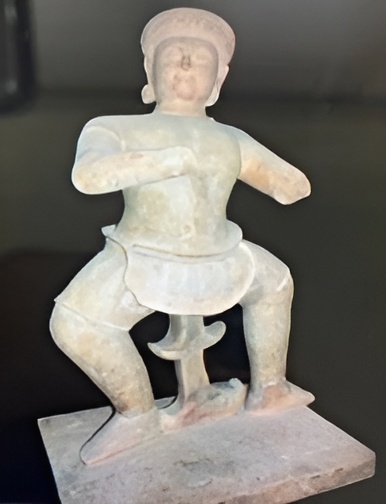
This is a statue of Bhima, Son of the Wind or Wajú, made of greenish-grey sandstone. It originated from the western gate of Prasat Chen, Koh Ker, in Kulen district, Preah Vihear province. This statue was stolen from Prasat Chen, Koh Ker temple. In 1975, it was rediscovered for the first time when it was traded on the black market.
The dealer was William H. Wolfe. Later, the exact year unknown, it was exhibited at the Norton Simon Foundation Art Museum in Pasadena, California, in the USA. On May 28, 2014, the museum returned the piece to Cambodia, where it immediately entered the collection of the National Museum.
Khmer art experts determined it is in the Koh Ker style, of the first half of the 10th century Angkorian period, during the reign of Jayavarman IV, from 921 to 941 CE. Bhima stands on a square three levels supporting platform. His body is slightly leaning to the right. Both feet turn in different directions.
The left foot has long toes that protruding from the base. His right-hand fold in and raised on the chest, higher than the left. His right hand used to hold a stone support in front between both legs, but this is now broken off. Traces of the end of the support remain at a point of contact with the base, near the feet.
The face looks up and slightly to the right. It bears a serious expression with eyes wide open. The head wears a diadem and a five-tiered crown. The ears are adorned with earrings, and the hands with bracelets and wristbands. The upper part of his body is bare, but the lower torso is dressed Sampot chong kben, that is held tight at the waist by a belt with a fishtail end hanging in the front.
Villagers living near the Koh Ker Temple complex say that many of the statues were excavated during and after the Khmer rouge rule as well as throughout the 1980s until 1997 to be sold in neighboring countries, especially Thailand.
This is unlike time prior to the Pol Pot era, when artist at Prasat Chen Koh Ker remained buried underground spared from the looting.