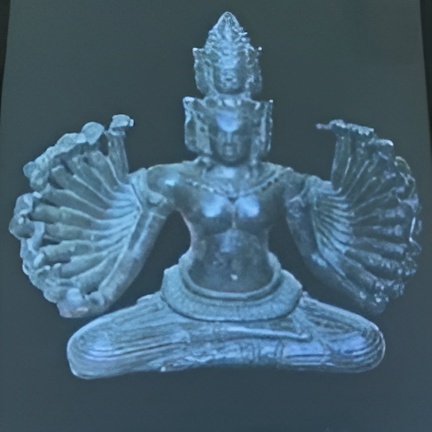
“This is an Eleven-Headed Tara, a Buddhist Bodhisattva. It is made of bronze. It originated from Koh Kong Province, which was previously part of Kampot territory. Originally, this object belonged to a Brahmin priest the King Norodom, who passed away when the Royal Palace was still located at Udong.
The authority of French protectorate brought this object from his son for amount corresponding to $55. And then included the collection of the National Museum on 11 September 1925. Expert of Khmer art have determined that this work belongs to the Bayon style and was created in the second half of the 12th century, Angkorian era, during the reign of the King Jayavarman VII from the year 1181 to 1218 CE.
This statue sits crossed legged, while simily explain her mind. All faces are different. The jewelry is very fine. And the long Sampot is finely folded around the hip, which id decorated with floral motifs. This divinity was recognized to be that of Praña Paramita, due to the Amitabha that sitting cross legged on the bun. In general, this kind of statue existed in the late 12th century. During this period, the Tantric Buddhist set was promoted. It was Bodhisattva’s attending enlightenment.
Especially with those who meditated with the wish to attend salvation. The statue has 22 arms, all carry objects as attributes, but since they are too small, it is impossible to identify each object. It can only assume that these objects were remain assist in meditation. The statue has 11 heads, four are on the first tear and face all four directions.”