
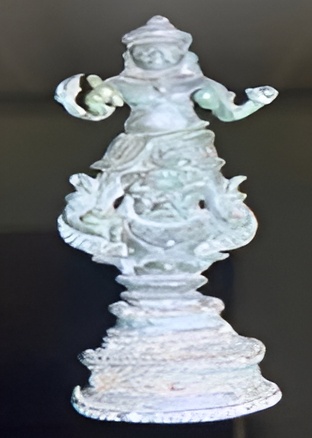
“This work showed Vishnu standing on the shoulders of Garuda. It is made of bronze. this work was registered into the collection of the National Museum in the pre-war period. However, to date, there are no available records to explain its origin and how or where it was found. Researcher also have yet to determine the date or era in which the statue was produced.
In Brahmanism, Vishnu is one of the three principal gods that governed the universe. Vishnu is the god of preservation and has Garuda as his vehicle. The reason Vishnu chose Garuda as his vehicle is explained in Brahmanism mythology, which describes a battle between the Theravada and the Asura.
The evidence supporting this image which has frequently been used by artists was first recorded during the Kushan era of India, in the 2nd century BCE to the 3rd century CE. In ancient Cambodia, the statue of Vishnu riding on the shoulders of Garuda symbolizes power and influence. As an artwork or image of the god it became very popular in the 12th century CE.
In this statue, Vishnu has a calm but serious expression on his face. He has a chignon on top of his head, and wears a neck chain, that has large amulet hanging to the middle of his chest. His four arms stretch forward at shoulder level.
They hold attributes such as a chakra, a shell, a conch an orb symbolizing the earth, and a stick. The upper part of the body is bare, while the lower part is covered in what appears to be a striped knee-high garment. Garuda spreads his wings in a position ready to move forward.
Beneath his legs is a three-tiered support that serve to stabilize the sculpture. This was a popular Hindu image during the 12th century Angkorian era. However, to date, there are no written records available to explain the use and function of these statues in Khmer society of the time. If you wish to learn more about Garuda becoming the mount of Vishnu, please press number 402 and then press the play button./.”