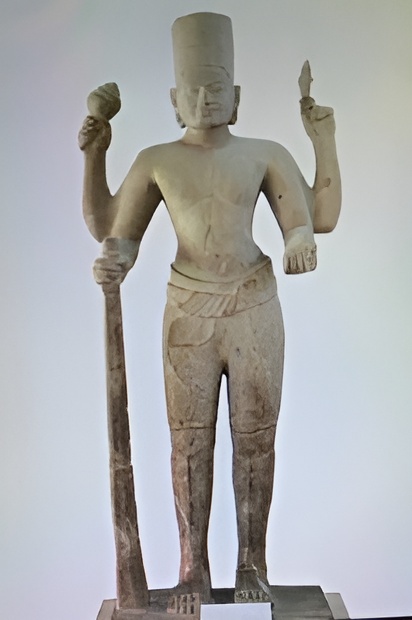
This is a statue of Vishnu. It originated from the northern gallery of the Damrei Krap monument, on Kulen Mountain, Siem Reap Province. Initially, the French School of the Far East took this work to exhibit at the museum in Hanoi in 1955, when it was returned to Cambodia and registered into the collection of the National Museum. Experts conclude that it belongs to the Kulen style of the first half of the 9th century in the Angkorian era, during the reign of King Jayawardman II, from the year 802 to 850 CE. He declared himself King of Kulen Mountain in the year 802 CE.
This statue shares many common characteristics with the Vishnu statue from Tuldaibhuvan in Preyveng province. Catalog number K1597. Although, the two works are about 200 years apart. They both wear a cylindrical crown. Both wear a short sampot that has fringes hanging loose on the left thigh. The only difference is that the Kulen- style statue has a large belt, and handle sampot tucked inside the belt with a protruding loop. The statue is standing posture with four arms, all of which remain intact. It is considered to be an adaptation of styles both before and during the Angkor period.
In some cases, statues of Kulen-style were created with a flexed waist. Artists practicing the style attempted to abandon the use of the using the horseshoe shape as a stabilizing mechanism, but were generally unsuccessful. They had difficulty in finding balance for the statues and resorted to carving a stone stick as a prop to prevent collapse. The size of this statue seems to project the persuade authority and might the Angkor Empire be enjoyed at that time. Although it appears a vivid representation, the modest expression is a slight departure from the feature depicted in the pre-Angkorian period. The two right hands hold a mythical disc of power, and a round object symbolizing the earth, while the left hands have stick and a conch.