
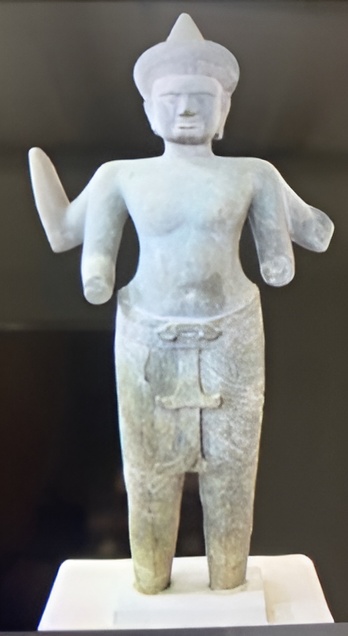
This is a sandstone statue of Vishnu. It originated from Wat Khnat in Angkor, Siem Reap Province, from where it was taken and registered into the collection of the National Museum of Cambodia in 1923.
Khmer art experts have determined it is in the Angkor Wat style, in the 12th century, Angkorian period, during the reign of King Suryavarman II, from the year 1113 to 1150 CE.
In Brahmanism, Vishnu is a deity creator, preserver, and protector of the world. Usually, his four hands hold four items as attributes.
A chakra as symbol of fire, a conch as water, an orb as earth, and the stick as wind. His vehicle is Garuda. This body post appears stiff and four hands are broken. Despite the damage, this sculpture has sustained, experts are able to identify Vishnu by the crown and the cone-shaped hairstyle. He wears a straight pleated Sampot. The main characteristic of this statue is the belt, which appears in the form of two rows of long cylindrical shapes.