
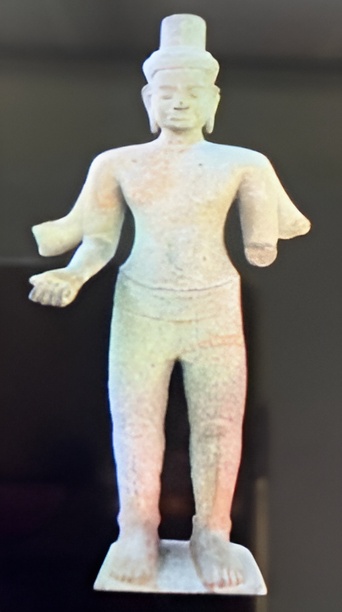
This work is a four-armed Vishnu statue, made of sandstone. It originated from the Preah Ko temple, Bakong District, Siem Reap Province. In 1923, conservation took it for safekeeping and registration into the collection of the National Museum of Cambodia.
Khmer art experts determined it is in the Bayon style of the late 12th or early 13th century, Angkorian period, during the reign of King Jayavarman VII, from the year 1181 to 1218 CE. All four arms have been severely damaged with the arms broken off at the elbows. This statue seem to be no different from other Bayon-style statues, where the head and decorative elements are typical.
Such as the chignon hair style which is adorned with a bit string. The ears are long. The upper body is exposed, while the dress is a knee high Sampot Chang Kben. The skirt is tight, angrez decorative floral waistband that leaves a fishtail like edge, dangling in the front and the back. The body posture appears stiff and the feet are large and lack beauty, which reflect the characteristics of the Bayon style.