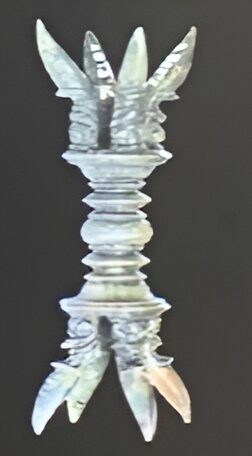
This work is a bronze Vajra. It originated from the Preah Theat monument in Chi Kraeng District, Siem Reap Province. Art authorities took for safekeeping, and were registered into the collection of the National Museum in 1922. Researchers determined it belong to the 12th or 13th century, of the Angkorian period, during the reign of King Jayavarman VII, from the year 1181 to 1218 CE.
The meaning of Vajra, a Sanskrit word is Thunderbolt, which in simple terms means powerful. This word gave birth to the Khmer word Vajra, or diamond, an object used in both Brahmanism and Buddhism.
In Brahmanism, it was attribute of Indra, who was the god of thunder and lightning, but this particular Vajra is an attribute of the Vajrayana or Peiyarayana branches. In other words, it is an attribute of Vayarasattva. It usually used in various Buddhist ceremonies, where a master of ceremonies holds it in the right hand with the bell in the left.
In Buddhism, Vajra doesn’t necessarily mean lightning, rather it means diamond which symbolizing purity and strength. In Tantric Buddhism, this object had great significance. This sect was often referred to as Vajrayana, which means the diamond vehicle. When it was intact, this Vajra had five pointed blades. Four of them represented the cardinal direction. The one of the centers represented the center of the world. By the way, in Buddhism, the five pointed blades represent the five Buddhas.