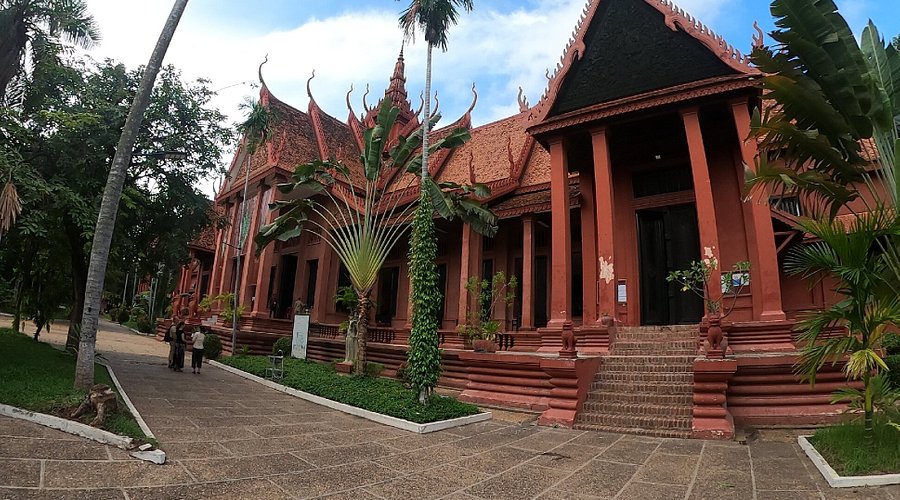
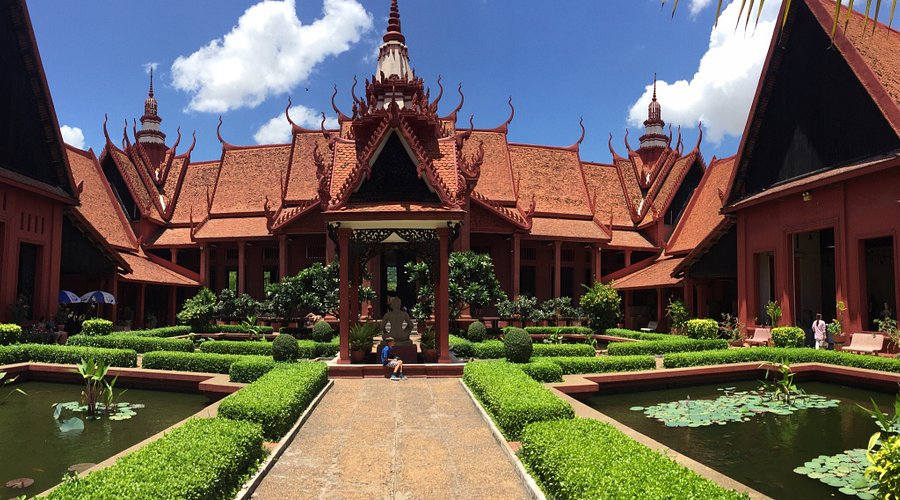
“When you look at the front sight of the museum through the main facade of the museum, what you can see is a rectangular and shape building built in style traditional Khmer’s architecture. The length of the frontal section is 66 meters. The depth from the front to the back rear is 54 meters. There are four galleries located at four sides parts that make up the building.
The garden located in the center is occupied by four ponds that home of various species of fishes and the number of aquatic plants aquatic plants, such as lotus and water lilies.
At the pavilion, with the tiered roofs supported by four pediments covered by central wood of arts. All pediments are carved with images of guardians with the faces turn toward the four directions. The building sits on the terrace 2.5 meters above the ground and it made of wood, bricks, and lime cement. The central roof structure rises 38 meters above the ground.
The roof frame is made of wood and covered by fish’ scales tiles. In Eastern Gallery roof has three towers. Each tower has multiple layers of pediments similar to those found of the tower at ancient Khmer Monuments. Each tower has Byromocoty which is the central of characteristic is Naga’s body stretching along the roof, with its head as elegantly as women and the tail is at the other.
The plan of the museum was designed by Georges Grolier and is an architecture masterpiece from the French colonial era.
The building is divided in four Galleries. The main door, which is at the east Gallery consist of two leaves. It is 5.1 meters high and 2.4 meters wide, and weighs a ton. It is a masterpiece produced by eight creatives artists, for masters and students of Fine Arts. Together they spent 45 days carving it in the style of Banteay Srey temple from the Angkorean era10th century.
The wall of the Eastern Gallery has 12 windows that feature similar carving to the door on the Western wall. Each interior window shadow has the painting that narrate Khmer folk stories.
Over time, the Southern, Eastern and Northern Galleries were expanded. The Eastern Gallery has five stairways and five large doors. The others three galleries have one door and one stairway. The doors of the Northern and Southern Gallery have been modified, to become false doors.
The door to the Western Gallery is opens occasionally for moving art objects or others equipment in and out of the museum. The windows in the Southern and Western Galleries were closed in 1969 as a safety measure prior to the civil war.
In 1969 refurbishment and modifications were made to the Eastern Gallery while original features remain concrete addition were added. One more floor made space for administration offices and the library. In the basement, a room was added for artifacts storage.
The National Museum was closed during the Khmer Rouge regime, from April 17, 1975 until 7 January, 1979. When the door is re-open, in 1996 the museum became the Head Quarter of the Museum Department. This Department responsible for the management of all museums across the country except the Chong Ek Museum in Phnom Penh and the Preah Norodom Sihanouk Angkor Museum in Siem Reap province. If you are interested in the history of Khmer Art, you can press number four and then press the play button.
“