
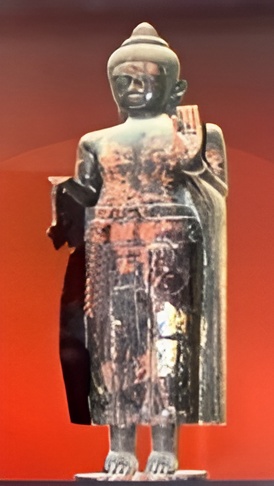
“This is a wooden Buddha statue. Which is 163 centimeters high. It used to belong to the Angkor Conservation in Siem Reap, but was later transferred to the National Museum, where it is now to registered into the collection.
Art experts believe it was made in the 17th century. Statues made in the 17th and 18th centuries extended the tradition of the ancient forms of the 15th and 16th centuries, by adding decorative elements and techniques such as lacquer.
This is an example of wooden artwork of the Middle Ages and also show the revival of the naturalistic trend. It also reflects the influence from the Bayon and Angkor Wat styles, that characterized by the vertical posture of the statue and the transparent robe.
The body of this Buddha is fully covered by the robe, from the neck to the ankles. Under the robe he has a second layer dress, called the Sbang, which is worn from the waist down and has two-folds hanging in the front. The right hand is missing, while the left shows the Avaya Mudra gesture, which means welcoming, fearlessness, and compassion.
This is a characteristic pose that was popular during the Middle Ages. The face of the Buddha features a calm expression and half-open eyes, with suggesting his strict adherence to the Buddhist code of self-conduct. Another special characteristic to note is the moly of hair, which is carved in a lotus shape to represent his wisdom and intelligence. The eyes are almond-shaped and are under connected eyebrows.”