
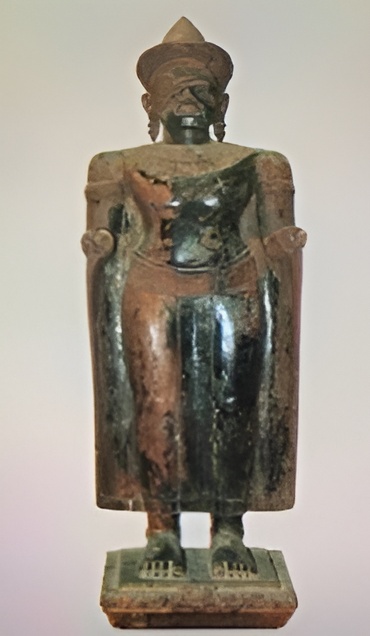
This is a standing Buddha made of wood.
It is 207 centimeters high and entirely coated with lacquer and red and gold paint. It originally belonged to the Angkor Conservation in Siem Reap. But was later transfer and registered into the collection of the National Museum of Cambodia.
According to art experts, it was made in the 15th or 16th century. The characteristics of this statue, especially the standing posture and the transparent garment, reflect the revival of the naturalistic trend that was associated with the art of the Bayon and Angkor Wat styles. The surface of this statue is coated in lacquer to hide traces of joints and cracks, and also to keep wood-boring insects away.
The head wears a molly hairstyle, shape like a flame with reflect the influence of art from Sri Lankan. The shiny surface on the statue signifies the knowledge and intelligence projected by his body. He is wearing a robe and from the waist down pleats drops along the legs, characteristic of art from the post-Angorian period.
This is an example of the art of the Middle Ages, when objects were mostly made of wood. Both hands are missing, but almost certainly they were in the Abhaya Mudra gesture, which means welcoming, fearlessness and compassion.