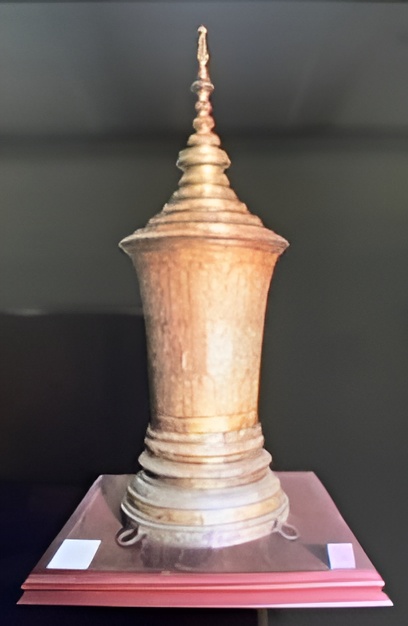
This object is an Urn made of wood and copper standing 289 centimeters high. Its origin is the Royal Palace in Phnom Penh. This Urn was made in the early 20th century and then donated for preservation at the National Museum in 1960.
Before it was presented to museum this Urn was used to keep the bodies of four kings prior to cremation. There were King Norodom, or Preah Sovanna Kot, who pass away in 1906; King Sisowath, or Preah Reacheanu Kot, who pass away in 1928; King Sisowath Monivong, or Preah Borom Khatiya Kot, who pass away in 1941; and lastly, King Norodom Suramarit or Preah Moha Kachanakkot, who pass away on the 3 of April 1960 the father of the late King Norodom Sihanouk. The shell is made of wood and inside there is a copper capsule to hold the body. The exterior is covered by the layer silver-plated, dipped in golden color, and adorned with floral decoration.
It has a conical cover top by a long spire. On the uppermost part of this spire there are seven umbrellas reserved for the royal family, and on the lower, there are five more reserved for Buddhist monks. Also, part of this Urn is a square pedestal that was used to support it.
According to ancient traditions, the bodies of the king’s senior member of the royal family, and even though of the most senior Buddhist monks, were always preserved in this special Urn for a period of time before cremation. This was a centuries-old tradition at least since the Angkorian period.
Evidence of this are the images of Urns on the walls of the Bayon Temple. The ritual to bid farewell to a deceased King could be very lengthy and elaborate. Usually, when a King pass away, a ritual was held to invite his body into the Urn, that had been prepared for him while he was still alive. In the Urn, the body would be preserved in a sitting position with both knees up, similar to a fetus in a mother’s womb. This position symbolizes to return to the womb to be later reincarnated. When the time for cremation to begin, the Urn is put into a Naga adorned vehicle and to be driven and in a procession around the capital, before the Urn is moved to the crematorium. Once there, the Urn is opened to transfer the body into another a smaller wooden Urn made from the cardamom tree.
This last wooden Urn is then carried to be placed on firewood and charcoal used for cremation. In effect this Urn was never damaged and was used multiple times before it was presented to the National Museum in 1960.