
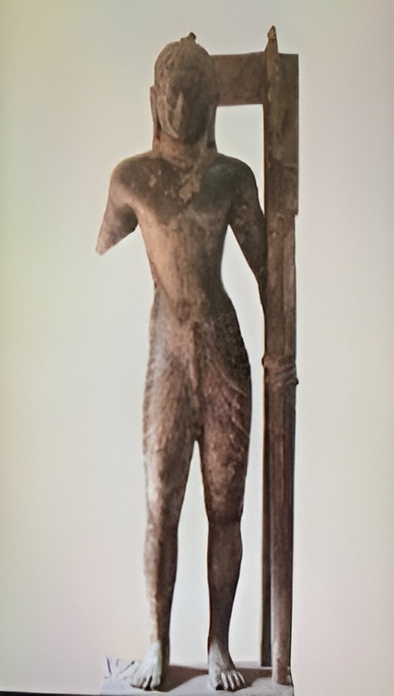
“This is a sandstone statue of a Rama. It is originated from Phnom Da, Angkor Borey District, Takeo Province. It entered the collection of the National Museum of Cambodia in 1936. Experts have determined that it belongs to the Phnom Da style in the 6th century, pre-Angkorian era.
The Phnom Da style is the oldest in Khmer art. Experts have classified 14 styles based on characteristics of decorative architectural: Lintel, column, pediment, single sculpture, and others. However, the sculptural form is still a key element for classification.
Henri Mauget discovered this statue during an archaeological excavation at Phnom Da in 1936. He also found two more. An eight-armed Vishnu and a Balarama. This work is a handsome image of Rama in a relaxed posture, one side of his hip lean slightly to the left. Art experts and researchers identified this statue as one of a triad in the Phnom Da style, in the collection of the National Museum. The triad consists of three figures: the eight-armed Vishnu in the center, Rama on the right and Balarama on the left. It is believed that this statue was made by one person or at least under the supervision of one master sculptor.
One of the characteristics of the Pre-Angkorian sculptures, especially from Phnom Da, was the use of a horseshoe-shaped support to connect the sculpture with the base as a stabilizing mechanism. Such a device was necessary for large statues that were sculpted to project movement.
The Phnom Da style was strongly influenced by Indian Gupta art, which is characterized by oval facial forms and they curved sharp nose, that differentiate images from the facial features of the Funan people, who wore braided hair falling down over the neck. In this statue, the right hand is missing, and his left hand is holding a bow, an attribute to Rama. He is wearing a Kben garment, which has a tail that tuck into the waistline at the back. This is characteristic of a male garment for a deity in the Phnom Da style.”