
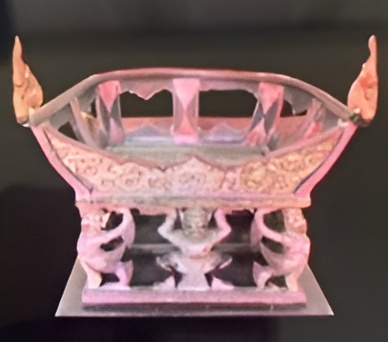
This is a wooden chair used by a senior Buddhist abbot at a ceremony to preach sacred scripts to Buddhist followers. A chair is coded in golden paint and lacquer. It originated from Wat Koh, in Angkor Borey district, Takeo Province and is now part of the collection of the National Museum.
According to art experts, it was made in either the late 19th or early 20th century. Judging by its design and decorative elements, this chair was designated for a high ranking venerable at the time. In past time, Khmer people just like other ethnic races residing in Cambodia, did not use a chair as furniture, as we see today. Instead, they prefer beds that came with different decoration, sizes and functions.
They were the same as this preaching chair, but sometimes could be in a shaped of a four-legged animal with a sitting platform on top. As for this chair, the supporting legs consist of four Garuda figure on the outer parameters, with a Yaksa in the center of each side.
In the past and still today, these creatures have been popular for use as decoration in the construction of sacred sites or buildings such as Buddhist Wats. They are found as decorative elements for columns or roof supports. By decorating the chair with these mythical creatures of Garuda and Yaksa, the artists wished to depict the abbot as a Heaven being.
As the imagined, the monk preaching from a chair that was flying in a cosmic world supported by these mythical creatures. In this particular chair, the Garuda and Yaksa are cast in handsome and courageous postures. They puff out their chests and spread their wing elegantly to support the chair.
The front is carved with an image of calla, who hold the moon with these two hands to squeeze into his mouth. The floor of the chair is made of plied wood topped with a soft cushion for the monk to sit on during a preaching session./.about 50 grams. It was brought from the Royal Palace and Angkor Thom district, Siem Reap Province, for displayed and later registered into the collection of the National Museum.
So far, experts have not been able to determine the date and era to which it belongs. The entire object is a Garuda figure with its head, body and feathers in intrepidly carved. It is in an upright position with its wings spread and the feathers standing erect. Hanging down his chest is a large necklace, where it pendants resemble a lotus bud.
To date, researchers have not been able to determine the function of this work. All we know is that Garuda is a vehicle of Vishnu.