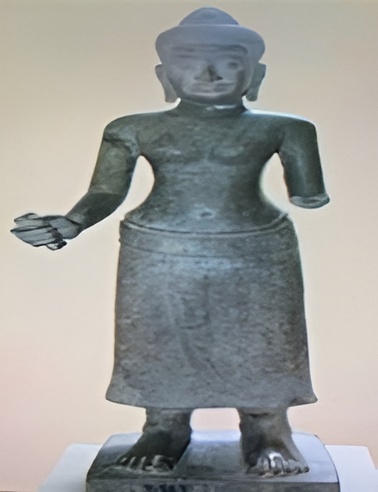
This work is a sandstone statue of Prajnaparamita. It originated from Banteay Chma temple, Thmor Pouk district, Banteay Meanchey Province. In 1935, it was registered into the collection of the National Museum of Cambodia. Khmer experts have determined it is in the Bayon style, of the late 12th or early 13th century, Angkorian period, during the reign of King Jayavaraman VII, from year 1181 to 1218 CE.
The hairstyle of Prajnaparamita is decorated in lotus petals and a three level conic shape and also has a carving of the Buddha Amitabha. The face is round in form and with closed eyes. The ears are long and have holes that remain for earrings. The left arm is broken at the elbow. She is wearing a Sampot Samloy that is studded with floral elements and tusk under the belt. A piece of the garment slang down of the front.
The body posture appears stiff and the feet are rather large, which is typically characteristic of sculptures during the era of King Jayavaraman VII.