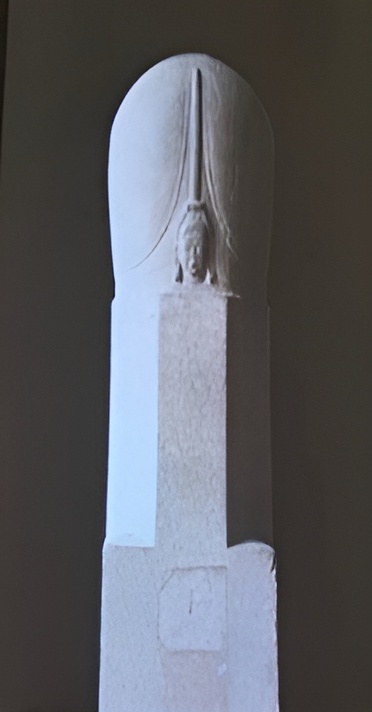
This is a sandstone Mukhalinga. Originating from Prey Veng Province. It is currently preserved as part of the collection of the National Museum of Cambodia. Researchers have determined that it was carved between the 6th and 8th centuries of the pre-Angkorian period. In the early day of Khmer art, Shiva was rarely sculpted in human form, but rather, more often in the form of a Linga.
Occasionally, Linga bear a human face, as seen in this work. This Linga, there are three distinct carved form to symbolize the three Hindu gods. At the bottom is Brahma, in a square shape to represent the four directions he oversees.
The mid-section has eight sides that represent Vishnu, the god who created the universe and is in charge all eight directions. The top has a round form which represents Shiva, the god creator, preserver, and destroyer of the universe. Shiva is sometimes worshipped in the form of a Linga. This sculpture is also known as a single faced Linga, as the only one face on earth.
This differs from those in India, where similar Linga bears a larger face of Shiva covering all the stone surface of one side of the Linga. Differently, in Southeast Asia, in particular in Cambodia, the face of Shiva on Linga is small and carved in relief, as shown in this example.
Linga was usually erected inside temples, especially at the central tower. It was the first image of Shiva worshipped by his followers. In a complete set, the sculpture would have the Linga placed on top a pedestal known as a Yoni, which represent his consort, Uma Phakawati. In the complete form, the two lower sections cannot be seen, as they are buried deep in the Yoni.
The image of the triple gods like this sculpture plays an important role in the Hindu religion, where Shiva is shown as the most important god, while Brahma was the first to fade before the other two.