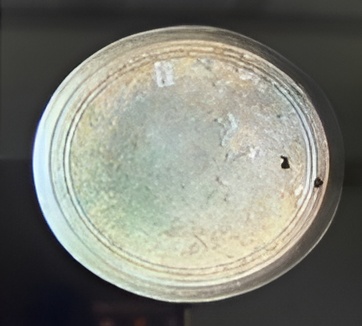
This mirror is made of bronze and weighs 1.1 kilograms. It was brought from Battambang province for display and later entered into the collection of the National Museum.
Based on the study of its engraved patterns and available records, researchers have concluded it was produced during the Angkorian era, between the 11th and 12th centuries. In the 12th-century Khmer society, a bronze mirror was an important household item. Proof of this are the reliefs on the walls at Angkor Wat and the Bayon that show Theravada using mirror.
A wax mold was used to form this mirror, which is decorated with three concentric lines. However, researchers have not been able to determine the real function and role of mirrors in Khmer society or in religious contexts. It can be assumed that this was used as beauty aids, but their role in the social hierarchy is unclear.