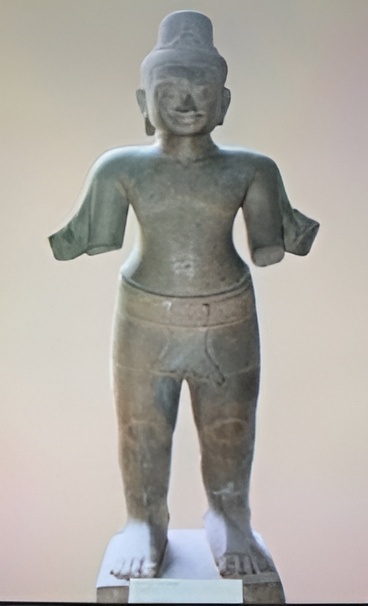
This is a sandstone statue of Lokesvara. It originated from the Angkor region in Siem Reap province. In 1930, it was taken from a temple for safekeeping and registered into the collection of the National Museum of Cambodia.
Khmer experts have determined it is in the Bayon style, of the late 12th or early 13th century, Angkorian period, during the reign of the King Jayavaraman VII, from the year 1181 to 1218 CE.
Standing on a square base. Lokesvara has four arms. All of which are missing below the elbows. The face is round with his close eyes and the chignon that is carved with an image of Buddha Amitabha.
The upper body is bare but from the waist down he is wearing a Sampot Chang Kben, that is tusk under a belt. The belt has floral decoration and fastened two fishtail like garment flinched slinging down in the front and two at the back. The feet are hug and the lack elegants which is a characteristic of the Bayon style.