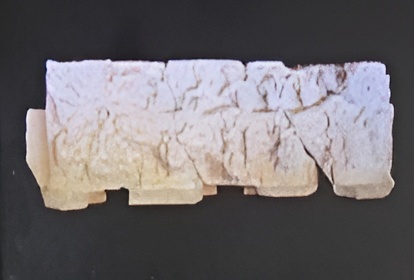
“This is a sandstone lintel. It originated from Sambo Prey Kuk temples, Sambo village, Sambo Commune, Prasat Sambo district, Kampong Thom Province. The work entered the collection of the National Museum of Cambodia in 1924. Experts have determined this item belongs to the Sambo Prey Kuk style, of the 7th century, Pre-Angkorian period, during the reign of King Ishanavarman I, from the year 616 to 635 CE.
This work shows musicians and Shiva dancing below belt motif. Shiva can be identified by the third eye he has in the middle of forehead. His right hand touches his chest and his left is behind his back. Crosswise on his shoulder, there are engraving of the snakes. The middle of the panel features an image of a bell and a standing Garuda with his left hand holding a garland of flowers. The bell also features images of Garuda fighting a Naga. The column capitals are festoon with images of unidentified creatures.
On the left, there are dancers: a conch blower, mump player and the junk striker. On the right, images of dancers: a drummer, bun player and possibly another junk striker at both end of the lintel. There are figure of Naga kings sitting crossed-legged. They are dressed in tight trousers held to the waist by a belt. The bodies are bared; the ears have huge earrings and on the head’s crowns with five Naga heads.
The image of the dancing Shiva has existed since the Pre-Angkorian era. The only exist on lintels of Sambo Prey Kuk temples. However, this style emerged again during the Angkor period. In this period, artists often sculpted dancing Shiva on pediments, lintels and columns of monuments.
It also appeared as an individual sculpture in Prasat Kraham at Koh Ker, in the 10th to 11th centuries. Beside this sculpture, the story of dancing Shiva is also narrated through inscriptions at Prasat Phnom Son Do and at Preah Vihear temple.
This image of Shiva as a dancing god is called Shiva Nataraja. The style of Shiva dancing is narrated in India sacred scriptures, which can show up to 108 manifestations, but artists show only seven of these, that are known in Khmer as Dandava.
The dancing Shiva is a depiction relating to his five powers in the universe. Namely: the power to destroy, to create, to protect, to recreate and to liberate oneself from suffering. George Closlier suggested that this lintel could have belonged to a monument that was dedicated to the Dancing Shiva.
It’s a reasonable suggestion, but due to erosion, it is extremely difficult for us to draw a definite conclusion. There are some details for consideration. The dancer appears to have four hands, and the head wears a conical crown resembling that a Shiva. The fact that the earrings worn by the Naga kings have different form from the jewelry worn by the dancing figure strongly suggests this is a sculpture depicting Shiva.