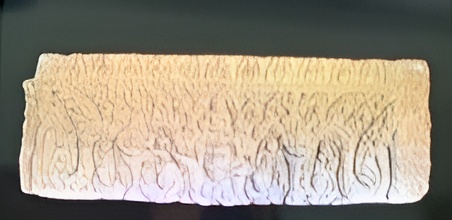
This is a sandstone lintel. It was brought from Kampong Speu province to display as part of the collection of the National Museum. In the Ba Puon style, it was made in the 11th century during the reign of Udayadityawarman II, from the year 1050 to 1066 CE.
At the center of the panel is an image of Indra riding on his vehicle, a three-headed elephant. In Hinduism, Indra is the god of the sky, who causes lightning and thunder. His main attribute is the Vajara, or thunder-bolt. In this work, the elephant’s trunk stands out prominently in the center of the panel. On both side, floral caving symmetrically decorates Indra and his elephant.
Between the two flower pendants is the head of Raju or Kala, whose eyes are wide open, and so is his mouth to expose his teeth. His beard extends to the lower edge of the panel. Both ends of the lintel are decorated with the carvings of Naga, whose heads are sheltered under rows of flowers. The panel has two sections. The lower section is occupied by the images of Indra, flowers, and Naga heads.
All framed with the one border. Above this frame, in the upper part of the panel, are 11 ascetic figures sculpted within niches of inverted lotus petals leashes. In aspects of Khmer architecture, lintels are almost always made of sandstone. They are usually sculpted in rectangular shapes to decorate gateways, doors, or false doors of a temple. Besides being a decorative element, they also serve a very important function to help support the weight of the monument.
“