
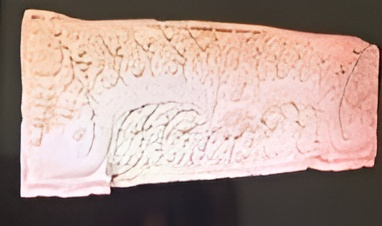
“This is a lintel, made of sandstone. It entered the collection of the National Museum a long time ago, but its origin is uncertain due to a lack of written records. Based on a study of its carved patterns and decorative elements, this lintel was carved in the Preah Ko style in the 9th century, Angkorian period.
There are three parts of this lintel. The first is Vishnu on Garuda, the second is the Naga, the third is the split leaf pattern. Vishnu on Garuda, his vehicle, is carved in a niche in the center of the lintel. In Brahmanism, Vishnu is one of the three principal gods, and his role is to preserve the universe. His vehicle is Garuda. In Hindu mythology, Vishnu standing on the shoulders of Garuda was depicted in a battle scene in a war between the Devata and the Asura. Artists often portrayed this image evidence of its first existence comes from the Kushan period in India, during the 2nd and 3rd centuries CE.
In Cambodia, during the Ancient Period, the statue of Vishnu on Garuda symbolized power and influence. It was most popular during the 12th century. In this statue, the artists portrayed Vishnu with a calm but serious expression, his eyes stair straight ahead. His forehead is adorned with a diadem.
The hair is form into a chignon. His four hands extend to the front and rise to level of his forehead to carry attributes: the chakra, conch, earth and the stick. The claws of Garuda formally grip the bodies of two Nagas. They are carved in a crush bold shape the tails and heads display the both end of the lintel. The bodies of the Naga have medallions.
Each has five heads facing the ends of the lintel. The spaces above and beneath the curved bodies of the Naga are deck with carving of split leaf patterns, where each element shape a spiral motif. In the history of Khmer architecture, lintels were mostly made of sandstone. They were usually sculpted in a rectangular shape to decorate the entrance, door or false door of a temple.
Besides being a decorative element, they also serve a very important function which was to support the weight of the monument.”