
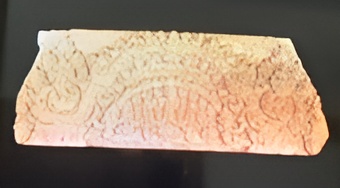
This work is a sandstone lintel. It has been part of the collection of the National Museum for many years, but its origin is unclear due to a lack of written records.
Based on a study of its carved and decorative elements, this lintel is in the Kampong Preah style, of the 8th century, pre-Angkorian period. The work is rectangular in shape. Evident in the center are carvings of intertwined floral motifs in arched shapes. The lintel divided into two areas, the arches and lower floral pendants. The upper section is carved with motifs known as Thnang Ampov, or sugarcane rings.
The top of the curve is carved in split leave shapes in 13 clusters. Both ends of the arch have carvings that resemble rounded shell tips or spiral motifs. Spilt-leave carvings elegantly stand on the upper section at both ends, accompanied by the motifs of floral pendants, dangling along the lower section of the lintel.
An expert of Khmer architecture, lintels are almost always made of sandstone. They are usually sculpted in rectangular shapes to decorate gateways, doors, or false doors of a temple. Besides being a decorative element, they also serve a very important function: to help support the weight of the monument.
“