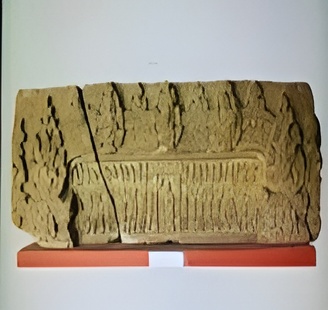
This is a sandstone lintel, which originated from Wat Enteak Koma in Kampong Svay district, Kompong Thom Province in Central Cambodia. Official in charge of Archaeological and Conservation Affairs, first took it for safekeeping in 1905 before entered into the collection of the National Museum of Cambodia in 1920.
Studies on the evolution and characteristics of this lintel have revealed that it is in the Prey Khmeng style of the mid-7th century, prior to the Angkorian period. Art of the short-lived Prey Khmeng style, emerged in the mid-7th century before quickly disappeared near the end of century.
Although elements of the decorative motifs, have suffered greatly due to erosion, this lintel has one high praise and popularity from researchers who classify among the masterpieces of the National Museum’s collection. At the time it was first recorded, this work was often referred to as the lintel of Wat Ang Kna, which is incorrect; in fact, it was discovered at Wat Enteak Koma in Kampong Svay district, Kampong Thom Province. This Buddha’s Wat was built on the site on an ancient monument, which date to the mid-7th century.
Built from bricks, the original monument suffered almost total destruction. Among the few treasure that remained were foundations that were beyond recognition in fragment including this is lintel. It should be noted that studies of the evolution of monument lintels have an able researcher to establish a chronology of The Khmer Art and their styles.
This is a good example of this under taking. The Prey Khmeng style is characterized by a curved axis running parallel to the lintel and adorned by three medal motifs in the middle and two larger ones at both ends, along with floral festoon. There are also festoon in the space below, which in some cases is filled with carved mythological images.
This lintel owes its reputation to two mythological stories. The Hindu statue carved in the upper section relates to the birth of a Linga and a Mukhalinga, which also called a Linga Tapavaramatei. The images in the lower section relate to the coronation of a king. On the left side, the bowl axis features gem motifs carved with a four-faced brahma. The right-hand side section features Vishnu with four arms. The two upper arms hold a chakra and a conch. The two deities are seated, to paying homage to the supreme deity Shiva.