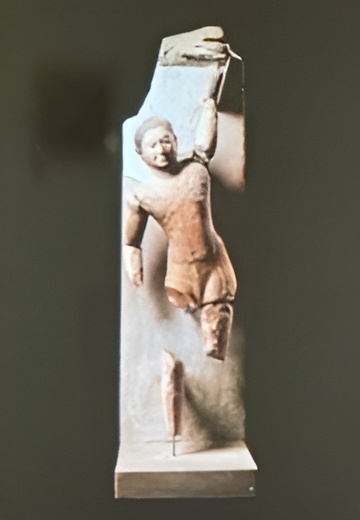
This is a fragmented sandstone statue of Krishna holding up Govardhana Mountain. It is originated from Phnom Da, Angkor Borey District, Takeo Province. In 1944, it was taking for safekeeping and registered into the collection of the National Museum. Khmer experts have concluded that it belongs to the Phnom Da style and was sculpted in the 6th century, Pre-Angkorian era.
The statue is in high relief. It is a magnificent masterpiece and one of the most popular of this time. Krishna is one of Vishnu twenty-four avatars, that held up Govardhana Mountain as told in the sacred scripture Bhagavad Gita Purana. According to legend, Krishna persuaded people in the Vaja region to switch their region and pay homage to the spirit of Govardhana Mountain instead of Indra. This caused outraging Indra, who was one of the supreme gods of heaven. In retaliation, Indra creates rain and storms, flooding the village and destroying crops and livestock as punishment for the villagers switching their loyalty. In response, Krishna uses his left hand to hold up Govardhana Mountain for seven straight days without rest, in order to shield the people from the thunderstorm.
These fragments come from a single work, but since both of Krishna hands hold up a mountain, and to note the entire sculpture to be stable enough to support itself, artists had to sculpted the relief from one large block of sandstone.