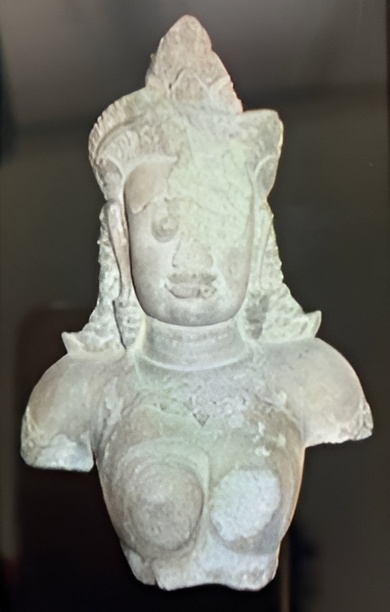
This is a statue of Kalichamuda, made from sandstone. It originated from Prasat Kraham Temple, Prasat Thom Temple in Koh Ker Village, Sro Yong Commune, Koulen District, Preah Vihear Province. Experts who studied it characteristics have concluded that the statue belongs to the Koh Ker style of the first half of the 10th century, Angkorian period, under the rule of King Jayavarman IV from the year 921 to 941 CE.
During his reign, King Jayavarman IV established his own capital city at Koh Ker. In the same period, the ancient city of Angkor, also saw successor reigns by two kings, King Harshavarman II and King Ishanavarman II, the sons of King Yajavarman I. According to a stone inscription at Neang Khmao temple in Takeo Province, King Jayavarman IV ascended the throne in 928 CE.
Soon after he became King, he starting building temples and other infrastructure systems throughout the capital city to demonstrate the scope of his power. Previously, it was believed that this statue represented a female giant. Such as assumption was drawn from the fact, that the head has fangs protruding from the mouth like the image of Asura.
But during of excavation in the year 2012 at the site of Prasat Kraham, conservator found the missing section to which the head belonged. That section included the torso and the pedestal, which has carved images of owls at the front and back. This discovery led Éric Bourdonneau, a French archaeologist from the French School of the Far East, to draw a new conclusion that the head and the newly this covered section were that of Kalichamuda.
She is a female deity who is related to Kali, one of consort of Shiva. With their vicious expression, the owl is her vehicle. The statue wears a crown, which decorated with lotus petal pendant. The decoration features designs from the Koh Ker Era. The statue has braided hair similar to other statues namely those of the Phnom Da style that is currently in the collection of the National Museum.
The excessive jewelry items worn by this statue are indication of the quality of the civilization enjoy by the ancient of Khmer society of this era. The statue has protruding eyes with two fangs protruding from the mouth. But not appear to project the kind of viciousness. One with expected a giantess to have.
In contrast, if project type of beauty, which reflected the creativity of the Khmer artists at the time. The statue conveys little meaning if view by itself. This is because used to belong to a group of statues that originated from Prasat Kraham, where a large statue of Shiva was in the center, surrounded by figures of lady Kalichamuda. This word is a combination of two Asuras, Chan and Muda, that lady Chan and Muda had killed. It is very rare to see a statue depicting Kalichamuda.
Excepting scenes on the lintels at Banteay Srey temple, that showed Shiva dancing. Please note that there are many similar scenes depicted by individual statues in Koh Ker, that echo one carved on Banteay Srey lintels.