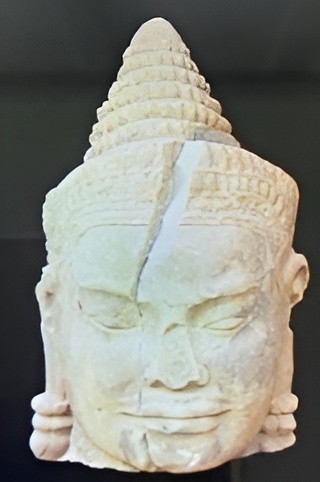
“This is a sandstone Head of a Devata. It has been part of the collection of National Museum for some time, but unfortunately lacks of any records of its origin and the exact location where it was discovered.
Based on a study Its decorative style and face form, this bear characteristics and similarities to those of the Bayon style, Angkorian era, of the late 12th or early 13th century, during the reign of king Jayayvarman VII, from the year 1181 to 1218 CE.
The head wears a semicircular diadem, and feature a calm and charming expression. The eyes are half closed and rest under arched eyebrows. The hair is fashion into conical-shaped decorated with four layers of lotus petals and with the same embellishment for the earrings. According to available records, this head is likely to be from the one of the statues that were found to be at major entrances to Angkorian monuments, especially those that were built in the Bayon style, for instance Preah Khan and the Bayon temples.
There, the Heads of divine being, demons and the Naga rail are symbols that derived from Hindu mythology together they depict a scene in mythology where Devata and Asura took part in a challenge to churn the Ocean of Milk in order to extract Amrita.”