
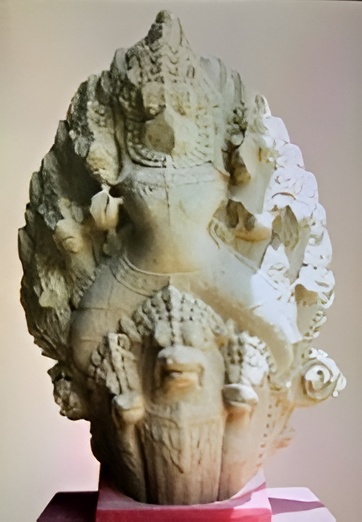
This work is from a sandstone balustrade, carved with images of Garuda sitting astride Naga. The government of Thailand returned this sculpture to Cambodia on 31 October 1996. Its place of origin remains unclear.
Based on the decorative elements and carved motifs, it is most likely this was sculpted between the 12th and 13th centuries, during the reign of the King Jayavaraman VII, from the year 1181 to 1218 CE.
The statue is divided into two sections. In the first section, there is an image of Garuda spreading its wings while standing on the Naga. The Garuda has bulged eyes and a pointed beak. On its head, there are cluster of patterns that symbolizing erect feathers. He wears a neckband. The Garuda is dressed in a knee high short Sampot that is tucked under a belt. The second section is the five headed Naga that is Garuda stands up on.
The Naga also wears a decorative item that appears to be a neckband. Its eyes are protruding as is sparing know energy in try to support the weight of Garuda. In ancient times, The Garuda on Naga balustrades was a very popular architectural addition that Khmer ancestors used to decorate gates, doors and entrances monuments or sacred religious sites. In most cases, it was sculpted and erected at the first entrance into a temple.