
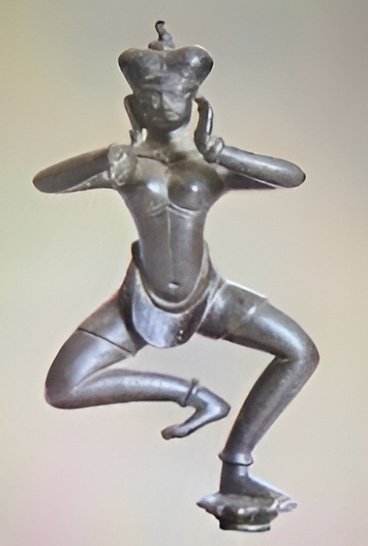
This work depicts a solo female dancer, made of bronze. It enters the collection of the National Museum of Cambodia on the 28 September 1924. Unfortunately, we do not have any records as to its origin. It is a miniature of lively statue that stands out to naturalism. It does not project any resemblance of power or sacredness, as what Deva images.
Figures of dancing lady were sculpted on the temple walls such as Angkor Wat and the Bayon. This statue is rare as it was made to appears alone. She is performing a dance, it has a similarly that we can find in contemporary performing arts, but ancient dancers, originate performed in homage to divinity. Her hands suggest gentle moves.
Her right foot is lifted and her back curved to synchronizing with the beat of the music. It is unusual to note the absence of jewelry, decoration and the headdress that we would find on the performer of the present time.
Her face bears a smile with the suggestion; she may has had a special status in her profession. She is dressed in a Sampot Chang Kben, which is tied at the waist by a belt with butterfly wings at the back. The characteristic of the evolution from the Ba Puon to the Angkor Wat style in ancient Khmer art.