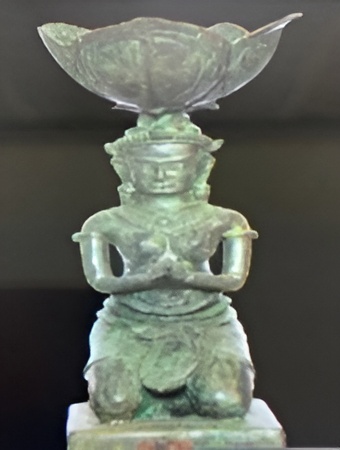
“This work is a bronze censer shape in a lotus flower form, supported by a kneeling female figure. It may have also function as a lamp.
It originated from Dong Run village, Mongkul Borey district, Banteay Meanchey province. It was registered into the collection of the National Museum of Cambodia in 1925. Khmer art experts determined it belong to the Bayon style and was created in the late 12th or early 13th century in the Angkorian era, during the reign of king Jayawardman VII, from the year 1181 to 1218 CE.
The bowl is shaped into four lotus petals, and there are traces of burning at its base. Evidence suggests it was used to store oil or heat fragrances and was most likely was used in ceremonies. This assumption is made based on the posture of the lady who support the bowl.
she is literally kneeling; her palms are placed together in a saluting or prayer pose. Her facial form small eyes, curved eyebrows, wide mouth, and the garment design all exhibit characteristics of the Bayon style.”