
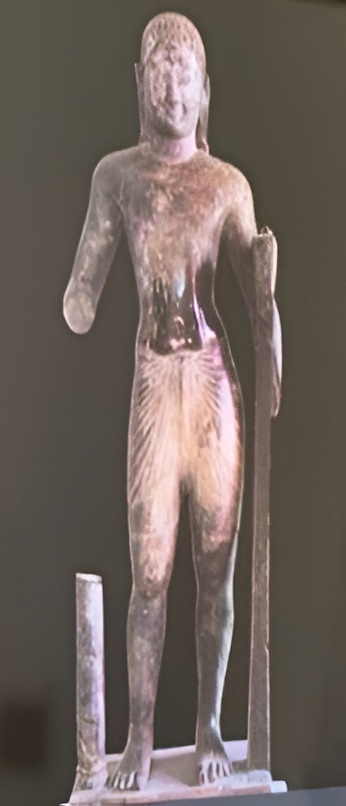
“This is a sandstone statue of Balarama. It originated from Phnom Da in Angkor Borey District, Takeo Province, from where were taken to register into the collection of the National Museum of Cambodia.
Khmer experts have determined that it is in the Phnom Da style, of the late 6th century prior to the Angkorian period. The Phnom Da style was classified into 14 categories, and the study of its characteristics is based only on statues.
In 1936, Henri Mauget discovered this Balarama during an excavation at Phnom Da, along with two other statues: the eight-armed Vishnu and Rama. During the pre-Angkorian period, Hindu statues representing the Vishnu sect were very popular as evidenced by the eight-armed Vishnu, the avatar Vishnu with the horse-headed, Krishna’s govardhana, Rama and Balarama.
Balarama is recognized by the plough he is holding his hand as his attribute. He is one of the ten or twenty-two avatars of Vishnu. In ancient Khmer art, he appears in two ways, as an element the stone carving and the mention in description. For example, on the pediments of the 10 century, Banteay Srey temple and the 11th century Baphuon temple, Balarama is feature in scene from the Mahabharata epic, which describe the fight between Bhima of the Pandava and Duryodhana of the Kaurava clans. In this conflict, Balarama remained neutral.
During the fight, Bhima committed an unlawful act by breaking the sight of Duryodhana’s. This was against the rules, which prohibited opponents from striking each other at body points below the waist. In witnessing an unlawful act, being committed by Bhima, Balarama wanted to intervene that was stopped by his younger brother Krishna.
This is an elegant statue. Balarama is in a standing posture, his hips sway to the left side, his face is round, his ears are long, and his hair is neatly combed, to falling over his long neck, like statues of Vishnu and Rama,
This work uses a horse-shoe arch and other mechanisms to stabilize it. The right forearm is broken up, while the remain left hand is holding the plow as his attribute. Balarama is dressed in a Sampot Chang Kben with multiple-pleats. The tail of the garment passes between the legs to the back, where it is tied to the waist line under a belt.
A small section of the pleat is left to protrude at the back. This is characteristic of the Sampot worn by male divinity in the Phnom Da style.”