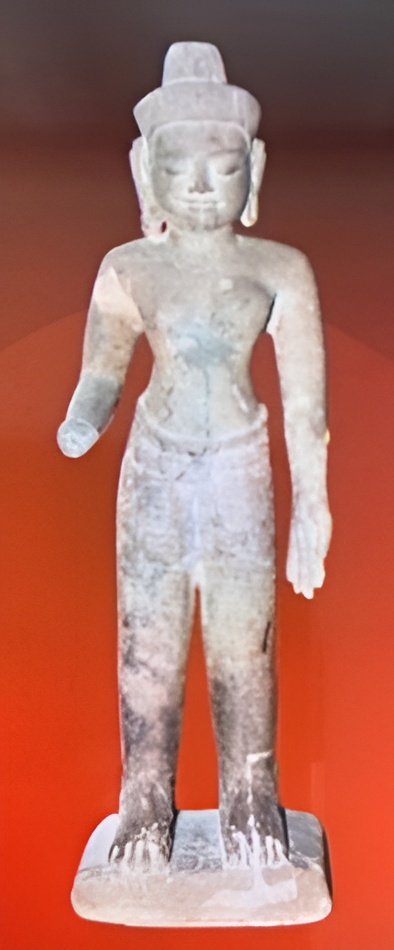
This work is a Ardhanarisvara and this made from sandstone. It originated from Sra Nge temple in the Roluos region, Siem Reap Province. It was first kept at the Angkor conservation in Siem Reap before being transfer in 1951 for registration into the collection of the National Museum in Phnom Penh. The statue belongs to the Bayon style of the late 12th or early 13th century of the Angkorian era, during the reign of King Jayavarman VII, from the year 1181 to 1218 CD.
In Sanskrit, Ardhanarisvara means a combination of half Shiva and half of his consort Uma in one body form. This sculpture is half man and half woman. The male figure is on the right and the female on the left. The concept behind it is that single gender cannot yield results. Only the combination of the two opposite sexes, male and female, can lead to new life and productivity. One cannot exist without the other. Brahmanism has many gods, but only three that well known in Indian mythology. These are Brahma, Shiva, and Vishnu.
To the present day, only two of three statues of Ardhanarisvara are known to have ever existed in Cambodia. One, which originated from the Sra Nge temple in the Roluos region, Siem Reap Province, is currently in the collection of the National Museum.
A second was registered in the collection of the museum in Battambang Province, but was lost during the civil war. Its whereabouts remain unknown. There is no notable characteristic of Shiva on the statue. However, close examination reveal immediately that it is Ardhanarisvara. Although this already missing the right hand that might one of held an attribute in the palm. The conclusion is drawn on the following facts. On the right side, the statue has a flat chest, a beard, and wears an earring. The left side, meanwhile, does not carry many female characteristics, other than the bulging shape on the chest, which suggest a female breast. The left arm hangs down and does not hold any object. This statue is sculpted in the Bayon style from the late 12th or early 13th century.
Generally, Bayon era sculptures appear stiff and lack crafting. The legs are usually large and not in proportion to the body, unlike the slim legs of pre-Angkorian statues. Compare with the subject of Khmer statues, this is rare. There are some unusual features to take note of.
Normally, the skirt has the fishtail like hem in the front, but on this statue, it is at the back. The sculpting work does not appear to be thorough, as those was quickly made. It can hardly be considered a provincial art piece, as the Sra Nge temple was situated within the Roluos complex, which is not far from the Angkor capital.
In most cases, Ardhanarisvara was depicted in a standing posture with two arms. This one has lost both arms, which makes it impossible to know what they were originally holding. There are exceptions, for a statue from the Baphuon temple and another one from the Sra Nge temple, each carry a trident in the right hands and a sacred book in the left.
As for the statue from the Sra Nge temple, which is currently in the collection of the Phnom Penh National Museum, its right hand is broken. The French conservator Jean Voselier, who saw the hand when it was still attached to the statue, said it was carrying a trident. Meanwhile, the left hand is in the Varadamudra, which means a gesture of Sakhor. The characteristic of this Ardhanarisvara statue, are not very obvious as another statue, and it take closer examination to identify them.
As in India and other countries, what makes it different from the others are body composition, hairstyle, mustache, beard, chest, jewelry, and the other attributes of Shiva. On the statues from the Sra Nge temple, the skirt appears as one, not as two separately carved elements, where the short garment is for Shiva and the long one for Uma.
Although the Sra Nge temple, statue seems to show that Ardhanarisvara is a single god wearing a single garment, the inscription suggests otherwise. This means that whenever Khmer people spoke of it, they referring to two separated bodies combined together, Uma and Shiva. Based on the inscription and the few available statues, we can conclude that Khmer people at the time were able to grasp the Indian concept or philosophy behind the joining of the two figures.
That concept was to show Shiva and Uma engage and sexual intercourse for having sex. In other word, it is sexual intercourse between male and female figure to produce offspring. The Baksei Chamkrong inscription has underline that sexual intercourse between Shiva and Uma, as portrait by a single statue, led to the creation of the world.
This concept of sexual intercourse between Shiva and Uma was narrated in sacred scripture in the Matsya Purana and the Linga Purana, which compared to the shape of Linga and the Yoni. In northern India, Shiva in this kind of Ardhanarisvara statue was the splat having an erection, as those, he was in the middle of sex.