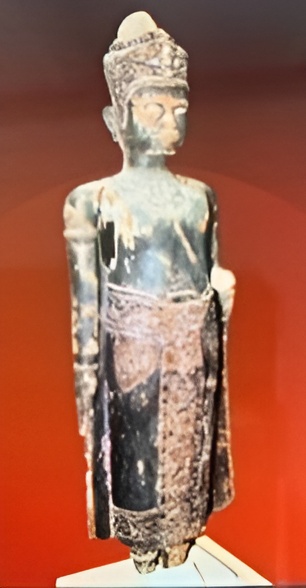
“This is a wooden Adorned Buddha which is 152 centimeters high. It is originated from Angkor Wat, in Siem Reap province. It was initially kept at the Angkor’s conservation, before been transferred and registered into the collection of the National Museum in 1975.
According to experts, this statue was made in the 15th to 16th century, post-Angkorian period. Previously, this statue was installed at the floor of a Thousand Buddha Figures at Angkor Wat, as part of the shift of the society at the time from worshipping Brahmanism and Mahayana Buddhism to Theravada Buddhism. In the post-Angkorian period, construction of gigantic monuments and stone statues ceased they were replaced by the creation of wooden Buddha statues of Gautama. Angkor Wat during the 16th centuries was transformed into a Theravada Buddhism center the large Buddhist Wat for followers from near and far to take part in pilgrimages.
In practicing their new faith both kings and Buddhist pilgrimages brought wooden Buddhist statues to keep at the temple. The number kept increasing to the point that this gallery became known as the floor of a thousand Buddha figures.
Buddha is fully covered in a robe from neck to ankles, a dress code indicating one who was ordained. The face features a calm expression with the eyes looking downward, which show an influence of the Bayon art style. The right arm drops parallel with the body, while the left, before it was lost, was raised in the hip in the Abhaya Mudra gesture.
He wears a crown, a neckband, wristbands, and anklets. The crown has four facets that are adapted from the angled crow form of the 13th century Angkorian period. On the right side of the crown there is a flower stem, which is likely to have its origin as a decorative flower put on the ear as characterized in Ayutthaya art. The robe is folded making two layers along the legs and fashion by an elaborately decorated string. Along both sides of the two layers. Additional representation of garments layers is evident; this could be the ends from the string tied of the hip which is a characteristic of sculpture for a male divinity in the Angkorian period.”