
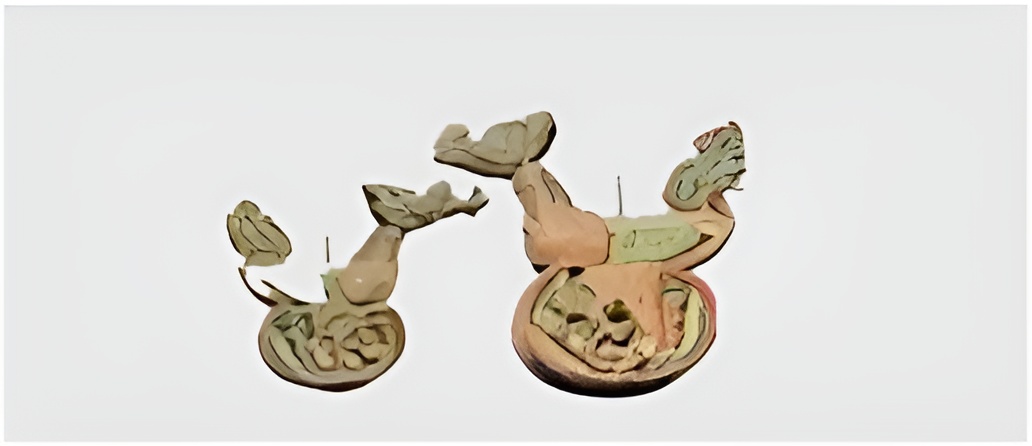
Artifact: 234
These items are wooden Weaving Equipment or Accessories, that currently in the collection of the National Museum. The object, marked with number GHA 234, is a pulley made of wood and covered in lacquer and red paint. It is believed to be from the 19th or 20th century. Its place of origin is unknown.
It is in the shape of the mythical bird Hamsa and the 13.3 cm high.
It is believed to be from the 19th or 20th century, and the origin Angkor Borei in Takeo Province, from where it was brought to be registered into the collection of the National Museum. The wedge is used for insert a roller to tightens the threads during weaving.
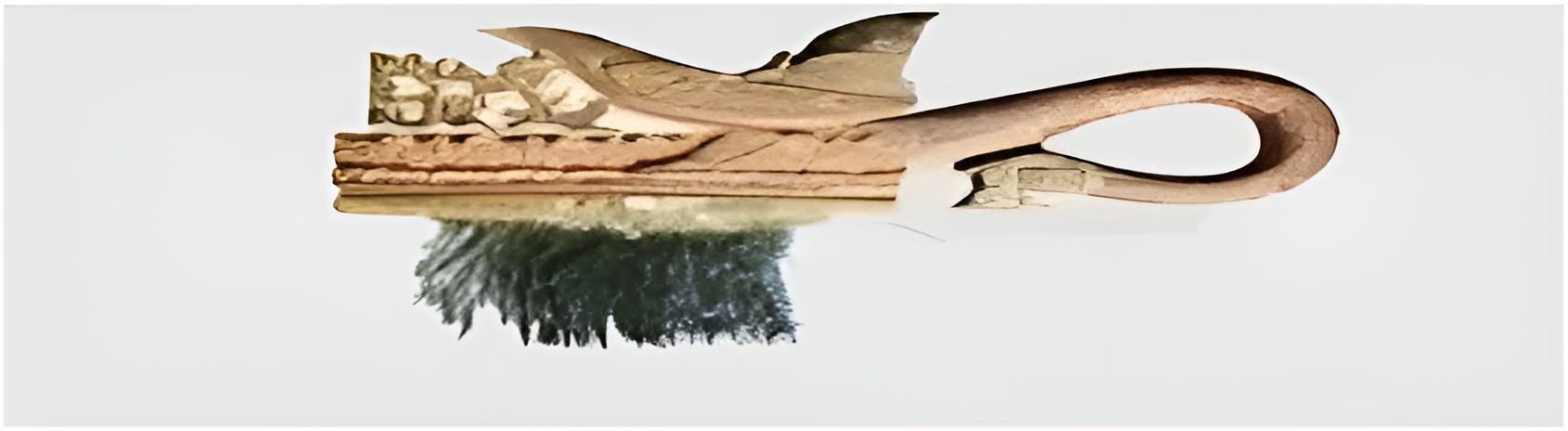
Artifact: 236
These items are wooden Weaving Equipment or Accessories, that currently in the collection of the National Museum.
The object marked with number GHA 236 is a brush made of wood and palm fiber and it is from the 19th or 20th century.
It is 28.5 cm long. Its place of origin is unknown. The brush is used for combing the cotton thread so that it does not become in tangle when weaving.
It is believed to be from the 19th or 20th century, and the origin Angkor Borei in Takeo Province, from where it was brought to be registered into the collection of the National Museum. The wedge is used for insert a roller to tightens the threads during weaving.

Artifact: 239
These items are wooden Weaving Equipment or Accessories, that currently in the collection of the National Museum.
The object marked number GHA 239 is the shuttle made of wood and is 34.6 cm long. It is believed to be from the 19th or 20th century; its place of origin is unknown. The shuttle holds the thread for weaving.Usually, the body of the shuttle is made of wood, while the heads on both ends are made of wood, bone or ivory, with carvings a decoration.
It is believed to be from the 19th or 20th century, and the origin Angkor Borei in Takeo Province, from where it was brought to be registered into the collection of the National Museum. The wedge is used for insert a roller to tightens the threads during weaving.