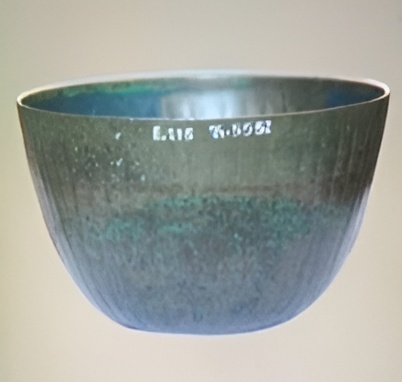
It is a bronze water bowl. It is 9 centimeters height and 17.5 centimeters in diameter and weighs 410 grams. It was brought from Bantey Meas district, Kampot province, for displayed and later registered into the collection of the National Museum.
Researchers to date have not determined the date and era of the production. Because of the green oxidation that has developed on exterior and interior, it is impossible to clearly see the engravings or learn anything from them. Only the base still has some traces of decoration. These include vertical stripes that circle the object before coming together in the center. The stripes resemble those that can be found on the skin of a pumpkin.
The bowl plays an important role in Khmer traditional daily life, as well as in religious ceremonies. To date, there are scant record available to definitively confirm its function in religious ceremonies. In general, Khmer people used the bowl to store water and other liquids. Researchers of archaeological sites suggest ancient Khmer people were also skillful in making water bowls, plates, water jugs and pots from clay and metal.
In studying the form and size of this bowl it can be assumed that was for used in religious ceremonies or for storing herbal medicine to treat illness. However, researchers are yet to make a conclusion of analysis.