
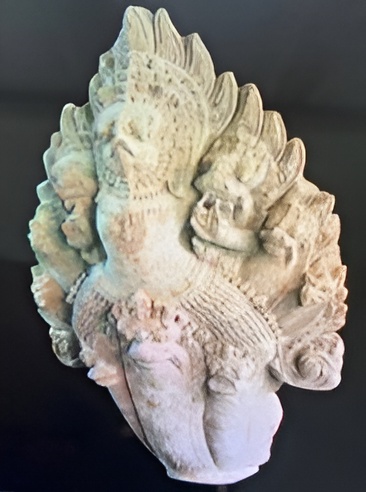
This object is a sandstone Balustrade finial decorated with Garuda riding on a Naga. This sculpture originated from the Angkor region, in Siem Reap province, and is now part of the collection of the National Museum of Cambodia. Researchers have determined it is in the Bayon style and was created in the late 12th or early 13th century, of the Angkorian period, during the reign of King Jayavarman VII from the year 1181 to 1218 CE.
In Hindu mythology, Garuda is the vehicle of Vishnu and the enemy of the Nagas. In ancient Khmer art, Garuda sculptures emerge that monument since the 7th century. During the reign of King Jayavarman IV in the 10th century and the reign of King Jayavarman VII in the 13th century, Khmer artists sculpted join Garuda and Naga statues with delicate decorative elements and a number of monuments.
In the 13th century, such statues became popular decorative elements in bar relief and high relief forms. They were feature as individual sculptures or decorative elements on pediments, lintels, colonnade, supporting base of statue and roof edges.
Since the 14th century to the present time, Garuda remains a decorative element in the construction of Buddhist monasteries and royal palaces. A form, sometimes appears as Kinara or Kenari on column capitals. These have played an important role in Khmer art by appearing in different forms and styles that correspond to respective periods.
As mentioned earlier, Garuda and Naga are enemies, but it is quite pestilent defined during the Angkorian period, this two being became united instead of in opposition as mythology. This flying divinity seems to be related to a mythological story that speaks of Vishnu sleeping on the Naga Ananda,When he awoke, he rode away on his vehicle, Garuda. In the Bayon style, Khmer artists sculpted Garuda riding on the Naga, perhaps to symbolize the unification in Khmer society of success generations. The Naga represented the moon, and Garuda represented the sun, which in turn represented the Khmer empire.