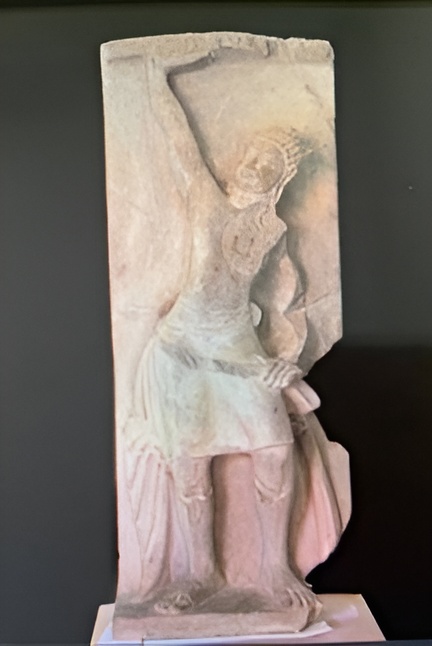
This is a statue of Krishna made from sandstone. It originated from Wat Koh, previously in Prey Kabas District, Takeo Province. It was registered into the collection of the National Museum of Cambodia in 1936. Khmer experts conclude that it belongs to the Phnom Da style and were sculpted in the 6th century, pre-Angkorian period, during the reign of King Rudravarman.
Angkor Borey is known to be the former center of the Funan kingdom. Most of the best sculptures found there, date the pre-Angkorian era and show strong influences from Indian culture. This influence was manifested by the triple flexing of figures. It is a characteristic that also can be found on murals on walls of Achanta region with images that show Krishna supporting a mountain.
Krishna was extremely popular in ancient Khmer society, and statue of him were made in countless number. The most popular among them were scenes where Krishna tur a Naga in two, while a same time holds up Govardhana Mountain. The presence of Krishna in Khmer society emerged in the 6th century, coinciding with the Phnom Da style. Carve images of him on temple pediments has pediments, lintels, pillars and walls, also appeared later in the Preah Koh style and continued into the Bayon style.
Krishna was sculpted in high relief on stone penal, that also served the function stabilizing and prevented the monument from collapses. The act of Krishna propping-up a mountain seems effortless. The body bends sharply to the right, and the left hand stretches its full length to hold up the mountain. It appears effortless, as there is no sign of bulging muscle as they should be with these kinds of weighting tasks. The right hand also appears relaxed, while holding on to a belt at the waist. His hair is braided in small round that needy aligned; the lower part of his body is covered in a Sampot or short garment, which is sucked between the thighs by the force of the wind.
This statue depicts a scene with Krishna as a young individual. He was a youth but mighty in powerful who dedicated his life to protecting the weak. Although he was young, he was still able to defeat Indra. In this scene, Krishna reaches out to help the herdsman by holding up Govardhana Mountain with his left hand for them to take cover.
The scene in this sculpture also shows the eighth incarnation of Vishnu. He was dark-skinned. As a child, his parents, Devaki and Vasudeva, swap him with the daughter of Nanda and Yasuda, who had many cows. Krishna ascended the throne at Dusharaka and had 16,000 wives, who gave birth to many children, but only one of them was single to be remember.