
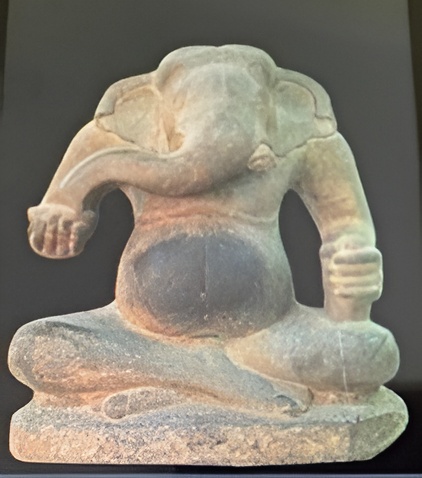
This is a sandstone statue of Ganesha. It originated from Toulphek Ka Nae or Toul Kouk Trab in Kandal Stueng District, Kandal Province. It is currently in the collection of the National Museum. Experts’ Khmer art has determined it was created in the Pre-Angkorian era, in the 7th to 8th century, during the reign of King Jayavarman I and Prehneang Jaydevi. This statue is a masterpiece of the Kampong Preah style. It is one of the deities that were often worshipped in the Hindu traditions of Cambodia at that time. Ganesha was a deity who both created and overcame obstacles. In other words, he is a deity that inspires human to overcome all obstacles in life. His abdomen has become shiny and dark as a result of countless touches of rubes he has received, an indication of his popularity in Khmer culture. Ganesha is the son of Shiva and Parvati, who had a human body with an elephant’s head. According to the legend, when Shiva returned from a period of living in solitude and meditation, Ganesha tried to block him from seeing his wife, Parvati. Ganesha didn’t know Shiva was his father. Shiva became so angry with Ganesha’s behavior, he cut off his head. Parvati was deeply grieved by what happened. Shiva then made her a promised to cut off the head of the first individual who passed by to put on the body of her son, Ganesha. Suddenly, an elephant emerged and walked by, and Shiva did what he had promised, cutting off the elephant’s head to reattach to his son’s body.