
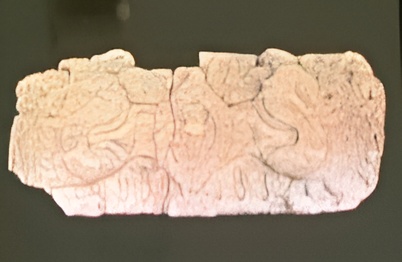
“This is a lintel made of sandstone. It is originated from Talaboriwat in Stung Treng Province, from where was taken to registered into the collection of the National Museum of Cambodia. Khmer experts have concluded this ancient object is in Sambo Prey Kuk style, of the 7th century, Pre-Angkorian era, during the reign of King Ishanavarman II, from the year 616 to 635 CE.
Art experts have noted that around the time of Sambo Prey Kuk style in the 7th century, the northern regions along the Mekong River, especially in Kratie and Stung Treng Provinces, were also home to many brick monuments. They two had door lintels with carved designs similar to the designs of Sambo Prey Kuk, except for some differences. They were smaller in size and had only one jewelry motif in the center, with a Makara creature that facing it, as seen on this lintel.
Experts classify this style as Talaboriwat style. This lintel is decorated in the center of the panel with a standing Garuda with both hands holding a Naga’s tail. The Garuda wears a Sampot Chong Kben that has a slanted edge in a fishtail form. Both ends of the lintel have images of Makara creatures facing each other. They appear to be swallowing or spitting out an axe. Each axe is short and has two lines of decorative elements.
The Makara creature has a trunk that curve upward, large eyes, a short body and buffalo-like teeth. It has on its head human figure that appears to be dancing. In mythology, Makara is a strange water dwelling creature. The surface of the lintel is adorned in flower garlands./.”