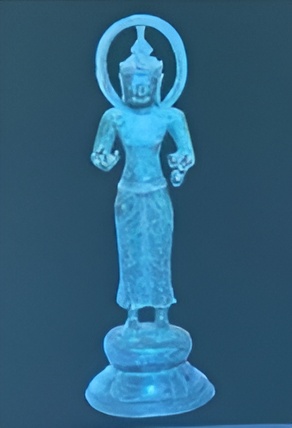
“This bronze Lokesvara is originated from Phnom Ta Kream in Battambang Province. Researchers have determined that it was created in the 8th century, pre-Angkorian era. Originally, there were two Lokesvara statues that looked straightly similar and were exhibited at Wat Popil Museum in Battambang.
When civil war broke out in 1970, many statues, especially the ones made of bronze, were transferred to the National Museum for safekeeping. This statue is identified as Lokesvara through the tiny figure of Amitabha on the chignon.
The slim figure wears a long Sampot with diagonal striped, which is a characteristic apparel worn by men in South Asian countries, such as India and Nepal. The Sampot is tied by a jewelry dots belt. He stands on a pedestal adorned with two lotus flowers, one facing up and the other facing down.
This statue reflects the influence of the art from the Srivijaya kingdom on the island of Sumatra, Indonesia, where Buddhism pros-birth in the 8th century. Also spread to the Malayan coast. Characteristics indicating this influence are the lotus like platform and the braided hair that brushes the shoulders. This Bodhisattva holds a jar in his left hand and a rosary in his right..”