
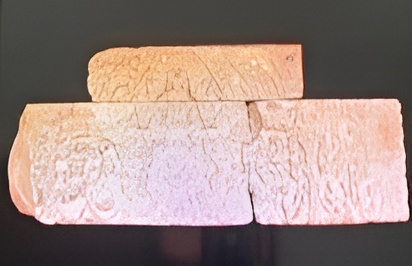
“This is a lintel made of sandstone. It was brought from Siem Reap Province for display and later registered into the collection of the National Museum. Studies of the decorative style have concluded this can be classified in the Bayon style, dating to the late 12th or early 13th century, during the era of King Jayawaraman VII, from the year 1181 to 1218 CE. This work originated consisted of many small blocks piece together in an overall rectangular shape.
Currently, there are only three individual sections left. Two of them are in the bottom row and the third is on top of them. In the center, there is a sculpture of Rahu, with his mouth wide open to show off his teeth. His beard extends to the lower part of the lintel. Above the head of Rahu is an image of Buddha in Abaya Mudra, with a fearless posture. He is in accompanied of two followers, who are kneeling and praying with him. Buddha is standing on a row of pillars above the head of Rahu. Both his and the images of Rahu were sculpted in a vertical oval shape niche. Both sides of the lintel are embroidered with flowers and a bow form.
In the history of Khmer architecture, lintels were mostly made of sandstone. They were usually sculpted in a rectangular shape to decorate the entrance, door or false door of a temple. Besides being a decorative element, they also serve the very important function which was to support the weight of the monument.”