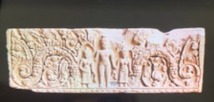
“This object is a monuments lintel, made of sandstone. Originated from Kampong Thom Province. It was taking into exhibit and later registered into the collection of the National Museum. Based on the study of its carved patterns and decorative elements, this lintel was made in the Baphuon style during the 11th century, Angkorian period. At the center of rectangular lintel, artists sculpted a male divinity in the companied of two female divinities on both sides.
The male divinity bears a gentle and polite expression. His hair is held in the stupa shaped chignon. He is wearing a thin, knee-high garment hang at the waist by a cylindrical belt. His right hand is resting on the left shoulder of one female divinity, while his left is holding the right hand of the other female divinity.
The three divinities are sculpted in a niche. The two female divinities wear diadems on their foreheads. Their hair is style in stupa shapes. They are wearing earrings that hang to touch their shoulders. The female divinity on the right of the male divinity is holding a blooming lotus flower. As for the female divinity to the left her right hand while holding the hand the male a divinity is also holding a lotus.
These three figures appear to be Shiva and his two consorts. From the center, where they are the three divinities figures two stems of braided flower in the crossbow shape extend, with the stem carved in the style of sugarcane joints.
Each branch ends with carving of inter twice elements that resemble spiral. The stems are deck with likely leaf decorations. In the history of Khmer architecture, lintels were mostly made of sandstone. They were usually sculpted in a rectangular shape to decorate the entrance, door or false door of a temple.
Besides being a decorative element, they also serve a very important function which was to support the weight of the monument.”