
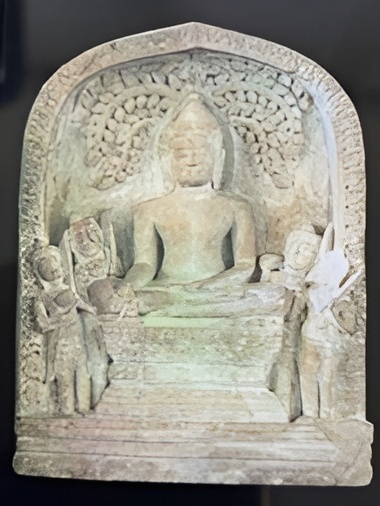
This is a sandstone relief sculpture of Buddha accompanied by four guards. It originates from the Bayon Temple, Angkor Thom, Siem Reap Province. And it is now part of the collection of the National Museum of Cambodia. Researchers have determined that it belongs to the Bayon style and was created in the late 12th or early 13th century of the Angkor period, during the reign of Jayavarman VII from 1181 to 1218 CE. Buddha is portrait sitting cross-legged, and apparently eating a meal on a pedestal under a bodhi tree. His left hand rests on his right leg, the palm turns up, the right hand also rests on the right leg and the palm turns sideways. His hair is braided and molded into a bun, that is similar to a lotus flower.
A characteristic of Buddha statues in the Bayon-style. He is dressed in a thin robe showing the style of garment of the time. On both side of the Buddha are four guards who have stick in their hand, and arms bowl in the right hand.
This statue shows Buddha, consented to accepted the alms bowls from the four worlds. According to legend, he refused the offer because three of the bowls were made from valuable materials, while the other was made of marble. The guards presented him with alms bowls identical made of marble which Buddha accepted. He then proceeded to place them one on top of the other, and with his magical power, all the bowls were suddenly transformed into one.