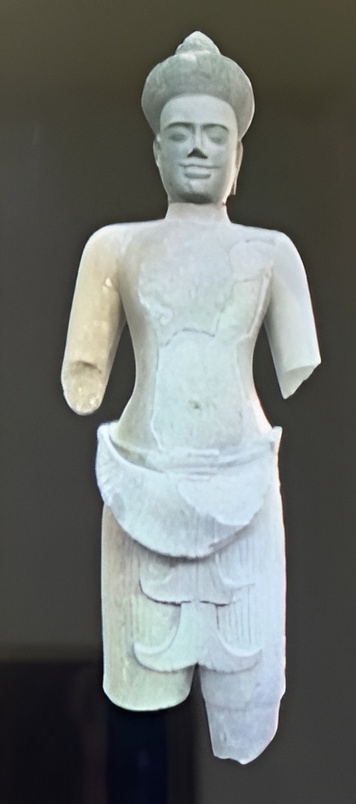
This is a sandstone statue of Shiva. It originated from Prasat Chrap of the Koh Ker monument group in Kulen district, Preah Vihear Province. It was transferred and registered the collection of the National Museum of Cambodia in 1954. Khmer art experts determined that it belong to the Koh Ker style of the second half of the 10th century, Angkor era under the reign of the King Jayavaraman IV, from the year 921 to 941 CE. Similar to other statues in the same style, this figure is large. As the legs are broken, it is unclear if this statue was carved out of one stone block, where both feet and pedestal were made from same stone. The same as other sculptures of other Koh Ker style, rather than different blocks piece together.
In this statue, Shiva is a strongly built figure, with wide shoulders a fixed chest and a large round neck. He carries a smile on his face, that feature a pointed nose, beard, and mustache. His eyes are open, and the eyebrows link straight cross to each other. The third eye is in forehead. The ears are long, likely to suggest the result of wearing heavy earrings. In Khmer beliefs, long ears could also be interpreted as a wise individual with a long life.
The crown has two decorative lines, one is known as the fish egg parent, the other as the lotus petals. The statue wears a short garment that has the large posh of garment folded over in front. It is fashion under a waist band. A close examination reveals that the artists have retain treasure of the Bak Kheng style, such as the waist band, the thickness of the garment, the tiny pleats, and the tail of the Chang Kben.