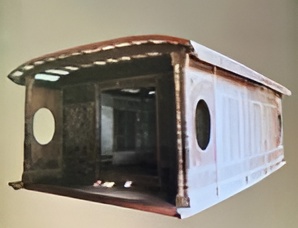
“This is a wooden Boat canopy. it is 204.5 cm high, 300 cm wide, and 560 cm deep.
Its origin is Wat Kampung Phluk, Kampung Phluk Village, Kampung Phluk Commune in Siem Reap Province. It is unclear when this boat was made, but the design tells us that it belongs to the 19th century, post-Angkorian era. At the end of the 19th century, the provincial governor donated this boat to the abbot of the Wat for use as transport. This village is a community on the edge of the Tonle Sap Lake. It floods regularly during the monsoon season, when the size of the Lake swells. Researchers, including Georges Joliet, saw a Buddhist monk rowing this boat in the lake and request permission to take it for conservation at the National Museum in 1930. Cambodia has a long history of water ways activities and trade that date to the Funan era of the 1st to the 6th century CE.
One of the major facilities for handling sea trade activities at this time was the Ok Au international port, now in southern Vietnam, in the province of An Giang. From the 9th to the 15th century, Khmer kings had moved the capital to establish capitals in the Mekong River area in Cambodia.
While trade played a key role in the general economic sense, it was irrigation engineering that had a major impact on the advancement of Angkor civilization. Fishing, water ways traffic, boat-making these are scenes of daily life from the ancient time that are depicted in the bas-reliefs of many monuments.
In the 17th century, when the Royal Palace was moved to Udong, the sovereign rulers at the time had a docking port build at Kampong Luong, about 30 kilometers north of Phnom Penh, now on National Road 5. Its primary purpose was to service royal boat when the king needed to travel between Siem Reap and Phnom Penh.
About a century ago, this kind of craft with the canopy were popular mode of transport for individuals of high status or for transporting Buddhist monks to religious functions. Unfortunately, this craft can now no longer be seen. Its overall exterior resembles a small house floating on water. It is about 5.6 meters long and 3 meters wide, with an art roof.
The exterior features a verandah about 80 centimeters wide. Inside it is divided into three-partition. Both ends have a door that led to the verandah, while windows are placed on both sides of the boat. The interior walls are usually adorned in decorative carvings of flowers, Nagas, and phoenixes which signify the influence of Chinese and Vietnamese art on Khmer art of the time. Sometimes these carvings also offering indication of the status of the owner, who may have been a district chief or a wealthy individual.”