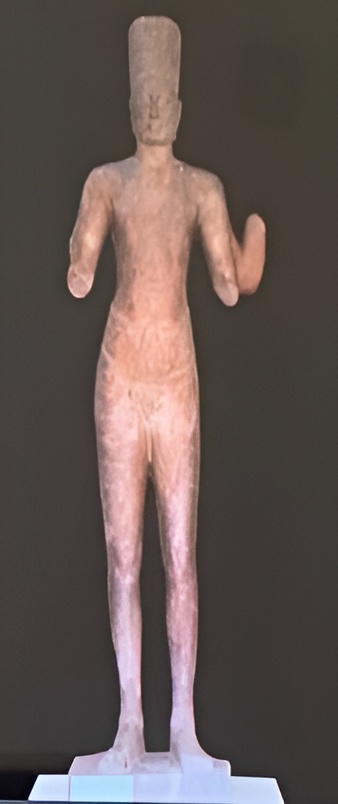
“This is a sandstone statue of Harihara. It is one of the rarest stone sculptures in the collection of the Khmer art. It originated from Prasat Andet in Kompong Svay District, Kompong Thom Province. Initially, this statue was kept at the Khmer Museum, the first museum opened in Phnom Penh, before the National Museum of Cambodia was established.
When the National Museum was opened in 1920, this statue was transferred there for safekeeping and registered in its collection. Experts in Khmer art say it in the Prasat Andet style, which is a unique style of the mid-7th century, Pre-Angkor period. Harihara is one figure comprised the half Vishnu and haft Shiva. Vishnu is on the left and Shiva on the right. Each of the two gods can be recognized by their respective attributes.
For example, Shiva can be recognized by the hanging festoon of his hair and have the crescent on his forehead and which is part of his third eye. Vishnu can be recognized by the half cylindrical crown on his head. The statue is in standing posture with the slim form reflecting the characteristics of the Prasat Andet style. The co-joined gods, Shiva and Vishnu differentiated from each other by only miner differences around the head.
For Shiva, his third eye was usually sculpted on the forehead. His hair was braided to falls on the right side. Another characteristic of this statue is that the shoulder muscles are visible, which is rarely seen in Khmer sculpture. This characteristic reminds us of sculptures of young men in ancient Greek art.
“